UK: What ‘Bottle Shop’ Means and Why Craft Shops Use It
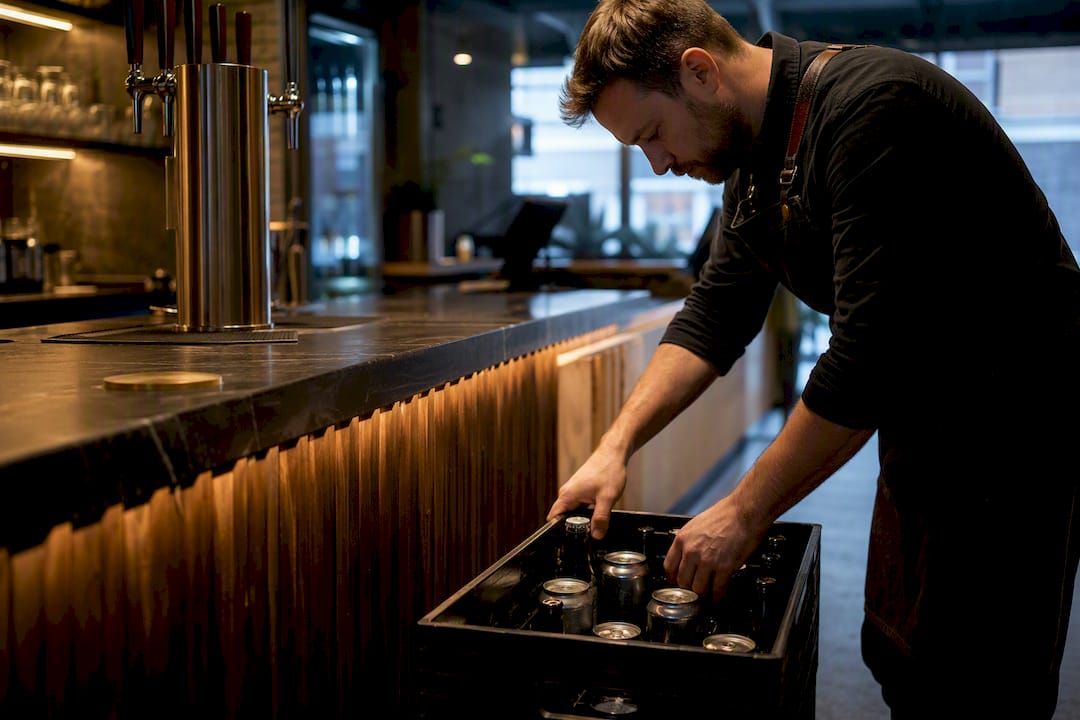
A bottle shop is a retail premise that sells sealed, prepackaged alcoholic drinks for people to take away and drink elsewhere. In British English, the equivalent term is an off‑licence, often shortened in everyday speech to an “offie.” The core idea in every version of the term is the same: you buy the bottle here, but you drink it somewhere else.
TL;DR:
- Most modern craft bottle shops curate their selection of bottled drinks to reflect what is available on tap, emphasizing quality over quantity.
- Licensing rules historically separated on-site drinking venues from retail outlets, shaping the distinct formats and locations of bottle shops worldwide.
- In the UK, “off-licence” remains the standard term, but some independent shops now adopt “bottle shop” to signal curated, craft-focused offerings.
- In Australia and New Zealand, “bottle shop” and “bottle-o” are the common terms, while South Africa prefers “bottle store,” and North America uses “liquor store” or “package store.”
- Many venues with onsite drinking licenses now also sell takeaway bottles, blurring the lines between taprooms and bottle shops, especially in the craft beverage scene.
Table of Contents
- Bottle shop meaning: the UK equivalent explained
- Where else is ‘bottle shop’ used, and what do locals call it instead?
- Bottle shop vs taproom vs supermarket: how to tell them apart
- Why the on-premises and off-premises split exists at all
- How a modern craft bottle shop treats take-home sales
- Sources
- FAQ
Bottle shop meaning: the UK equivalent explained
Ask a shopkeeper in Sydney for a bottle shop and they will point you towards the fridges of beer, wine, and spirits meant for carrying home. Ask the same question in Brighton or Bristol and you will get a blank look, because the shop you want is an off‑licence.
Both terms describe the same retail model: a shop selling packaged wine, beer, spirits, cans, and increasingly non‑alcoholic alternatives, all sealed for consumption elsewhere. Cambridge Dictionary and Collins both define the concept the same way, whichever regional word sits above the definition: a place selling alcohol to be taken away rather than drunk on site. The consistency between two major dictionaries matters here, because it confirms the meaning hasn’t drifted much even as the vocabulary has splintered across English-speaking countries.
That splintering is worth knowing before you land on the wrong search result or ask a confused local for directions. Here’s a quick reference for the words you will actually encounter:
- Off‑licence / offie — the standard UK term, used everywhere from corner shops to specialist wine merchants.
- Bottle shop / bottle‑o — common in Australia and New Zealand, with “bottle‑o” as the informal Australian shorthand.
- Bottle store — widely used in South Africa and parts of the Commonwealth.
- Liquor store / package store — the North American equivalents, with “package store” surviving mostly in a handful of US states.
- Craft bottle shop — a newer UK usage borrowed deliberately from the Australian term to signal curated, specialist stock rather than a generic corner-shop off‑licence.
None of these terms describe a different type of business. They describe the same job done under different regional labels.
Where else is ‘bottle shop’ used, and what do locals call it instead?
“Bottle shop” isn’t a British word by origin. It belongs primarily to Australia, New Zealand, and South Africa, where it describes exactly the same retail model as an off‑licence: a store selling sealed alcohol for off‑premises drinking, according to Collins Dictionary. In Australia specifically, you will hear “bottle‑o” almost as often as “bottle shop,” particularly in casual conversation.
A few regional patterns worth knowing:
- Australia and New Zealand: “bottle shop” is the default term; “bottle‑o” is the colloquial version, especially in Australia.
- South Africa: “bottle store” is the common phrase, functioning identically to a UK off‑licence.
- United States and Canada: “liquor store” dominates, with “package store” (or “packie” in parts of New England) surviving as a regional holdout.
- United Kingdom: “off‑licence” remains the standard term, though “bottle shop” has started creeping into craft retail branding.
That last point is genuinely interesting if you follow the UK drinks trade. Independent bottle shops specialising in craft beer, natural wine, or small-batch spirits have started calling themselves “bottle shops” rather than off‑licences, borrowing the Antipodean term specifically because “off‑licence” carries connotations of a generic corner shop selling supermarket lager and scratch cards. The word swap is a branding choice, not a legal or functional one. According to Collins, this adopted usage signals curation rather than commodity retail, even though the underlying licensing category hasn’t changed at all.
Bottle shop vs taproom vs supermarket: how to tell them apart
The distinction that actually matters, legally and practically, is on‑premises versus off‑premises consumption. A pub or taproom is licensed primarily for drinking on site: you order a pint, you drink it at the bar, and the container (if there was one) usually stays behind the counter. A bottle shop or off‑licence is licensed for the opposite: you buy a sealed bottle or can and take it away unopened, a distinction confirmed by Wikipedia’s overview of liquor stores.
Supermarkets complicate the picture slightly. Many now hold off‑licences and sell packaged alcohol alongside groceries, which puts them functionally in the same category as a dedicated bottle shop even though nobody calls Tesco an “offie.”
Taprooms sit in an interesting middle ground. Plenty of modern craft venues, including independent taprooms across the UK, sell take‑home bottles and cans from behind the same bar where they pour pints. That doesn’t make them bottle shops in the strict sense. Their primary licence and business model remain on‑premises drinking, with take‑home sales as a secondary offering rather than the main event.
If you’re trying to work out what kind of venue you’re actually looking at, run through this quick checklist:
- Check whether most customers drink on site or leave with their purchase. On‑site drinking points to a pub or taproom; leaving with the goods points to a bottle shop.
- Look at how the alcohol is served. Poured into a glass suggests on‑premises; sealed in the original container suggests off‑premises.
- Note whether there’s seating built for drinking, or just a till and shelving. Seating and bar stools indicate a drinking venue; shelving and fridges indicate retail.
- Ask if takeaway bottles are the main stock or a side offering. A side offering usually means you’re in a taproom with a small retail corner, not a bottle shop.
Pro Tip: If you’re ever unsure whether a venue can sell you a bottle to take home, just ask at the bar. Many taprooms, including independent ones, happily sell take‑home bottles even though their primary licence covers on‑site drinking.
Why the on-premises and off-premises split exists at all
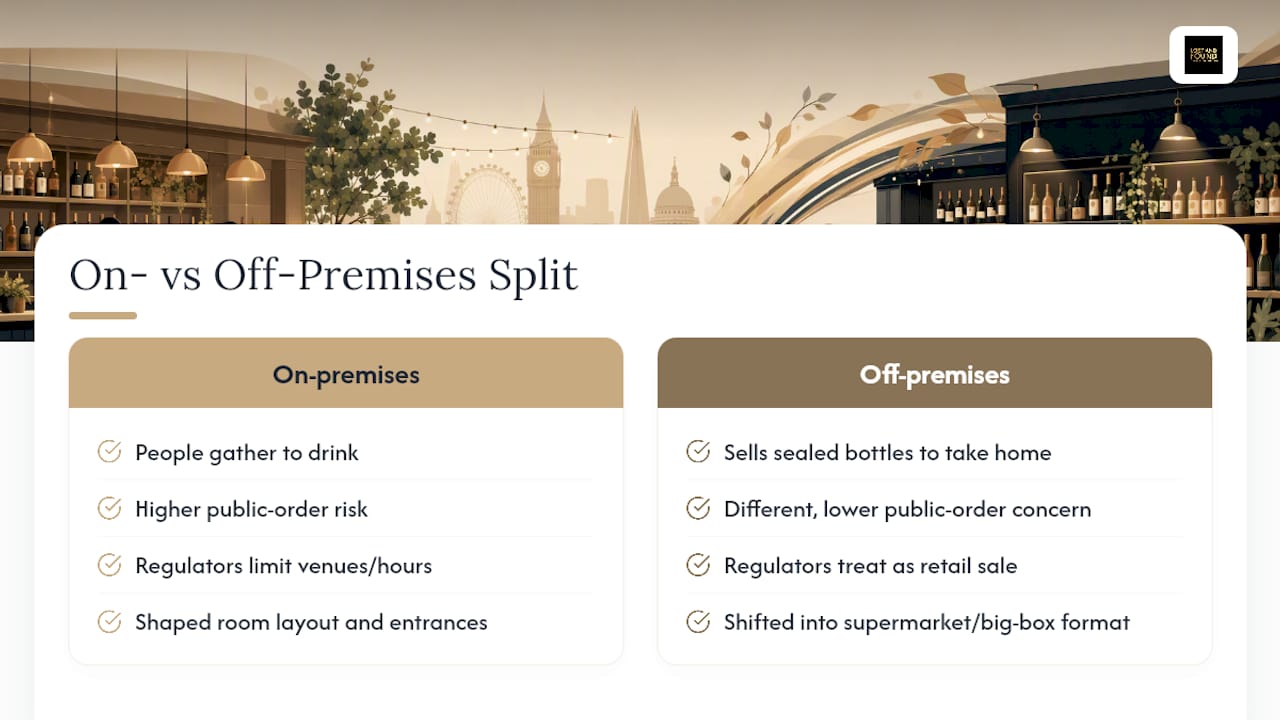
The line between drinking somewhere and buying to take away isn’t accidental. It was built deliberately, largely as a public order measure. Researchers at RMIT University note that licensing rules through the twentieth century used the on/off‑premises split as a policy lever, separating places where people gathered to drink from places that simply sold sealed containers for later consumption. The logic was straightforward: a shop selling sealed bottles for someone to carry home creates a different set of public order concerns than a room full of people drinking on site.
That regulatory pressure shaped more than just terminology. It shaped shop layout, entrances, and even where bottle shops were permitted to open. Academic work from Monash University traces how licensing changes in Melbourne pushed bottle shops away from small grocer-style outlets towards the supermarket-scale “big box” format familiar today, driven almost entirely by shifts in what regulators would permit and where.
None of this is universal, though. Licensing frameworks vary by country and often by local authority, covering everything from permitted trading hours to whether supermarkets can hold an off‑licence at all, per Wikipedia’s summary of liquor store regulation. If you’re checking what’s legally allowed in your area, the rules governing your specific town or council will matter more than any general definition.
How a modern craft bottle shop treats take-home sales
Most people picture an off‑licence as fridges of lager and a till by the door. That picture is increasingly out of date. A growing number of independent venues treat take‑home bottles as a curated extension of what’s already being poured on tap, not an afterthought bolted onto the side of a pub.
Lost And Found Taproom works this way. Alongside pours from rotating local and UK breweries, Lost And Found keeps a changing selection of bottles and cans available to take home, drawn from the same beer menu served across the bar. The point isn’t to compete with a supermarket aisle. It’s to let someone who’s just tried something unusual on tap walk out with a bottle of it, rather than trying to remember the name later.
That’s the real shift in how “bottle shop” gets used in the UK now: less a description of a shop type, more a signal that what’s on the shelf has been chosen deliberately.
— Author
Sources
- off‑licence | Definition & Meaning | Cambridge Dictionary
- off‑licence definition and meaning | Collins English Dictionary
- Liquor store — Wikipedia
- Drunk history: Bottle shops, urban life and public order — RMIT University
- Bottles in big boxes: liquor licensing regulations and the history of Melbourne bottle shops — Monash Research
FAQ
What do the British call a bottle shop?
The British call it an off‑licence, or colloquially an “offie.” Both terms describe a shop selling sealed alcohol for people to take away rather than drink on site.
What does “bottle” mean in slang?
In this context, “bottle” simply refers to the sealed, prepackaged container the drink is sold in, distinguishing it from alcohol served by the glass in a pub or taproom.
What is a bottle shop in the UK?
In the UK, “bottle shop” usually refers to an off‑licence, though the term has also been adopted by some independent craft retailers to describe a curated selection of specialist beers, wines, and spirits.
What is another word for “bottle shop”?
Common alternatives include off‑licence and offie in the UK, bottle‑o in Australia, bottle store in South Africa, and liquor store or package store in North America.