Avoid £500 Minimums: Compare Brighton Venue Hire by Cost Per Head
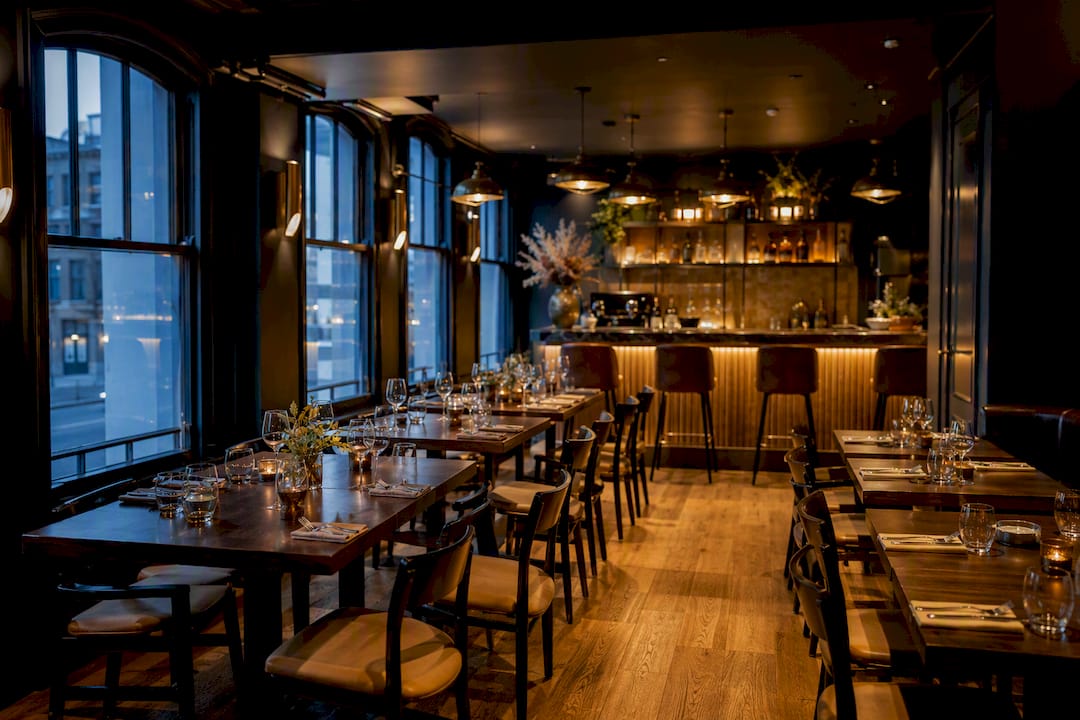
Small Brighton venue hire generally ranges from a few hundred pounds for daytime or weekday bookings, mid-size events with several dozen to around 150 guests usually cost in the low thousands, and large events with over 150 guests tend to cost more, especially after adding catering and staffing expenses. The number that actually matters isn’t the headline hire fee, though. It’s your total cost per head, the all-in figure divided by guest count, which is the only way to compare a minimum-spend pub against a per-head hotel package fairly.
TL;DR:
- The total event cost per guest, including all extras like staffing and catering, is the key metric for comparing venue prices accurately.
- Weekday and off-peak bookings generally cost significantly less than weekend or summer dates, especially for larger events.
- Prices vary by model, with fixed hire fees, minimum spends, per-head rates, and hybrid options influencing the final bill.
- Always request an itemized quote, include all mandatory extras, and divide the total by expected guests to compare venues properly.
- Lost And Found Taproom offers transparent, minimum-spend pricing without hidden fees, making it a practical mid-week alternative for Brighton events.
Table of Contents
- Quick price ranges and what they mean for your budget
- Pricing models explained (hire fee, minimum spend, per-head, hybrid)
- What a venue hire fee usually includes, and the extras to always check
- How to compare quotes properly using total cost per head
- Brighton’s pricing calendar shows clear peaks during popular events like Brighton Festival and Fringe in May, as well as general summer season increases, making advance booking important during these times.
- Typical contract terms and cancellation policies affecting cost
- Payment schedules and accepted payment methods
- Cost comparison with alternative event locations nearby
- Timeline overview from inquiry to booking to event date
- Lost And Found’s view on fair pricing and transparent quotes
- How to book Lost And Found for your event
- Sources
Quick price ranges and what they mean for your budget
Working out where your event sits on the Brighton pricing scale starts with guest numbers, not venue type. A tight guest list changes everything about which venues even make sense.
Small events (up to around 60 guests) typically involve either a hire fee of a few hundred pounds or a minimum spend on food and drink. Local marketplace data shows small Brighton venues commonly setting minimum spends from around £500, often lower for weekday afternoons. Community spaces can undercut that further. Queens Park Tennis Club, for instance, charges a straightforward hourly tariff around £40 to £50 with none of the minimum-spend complexity.
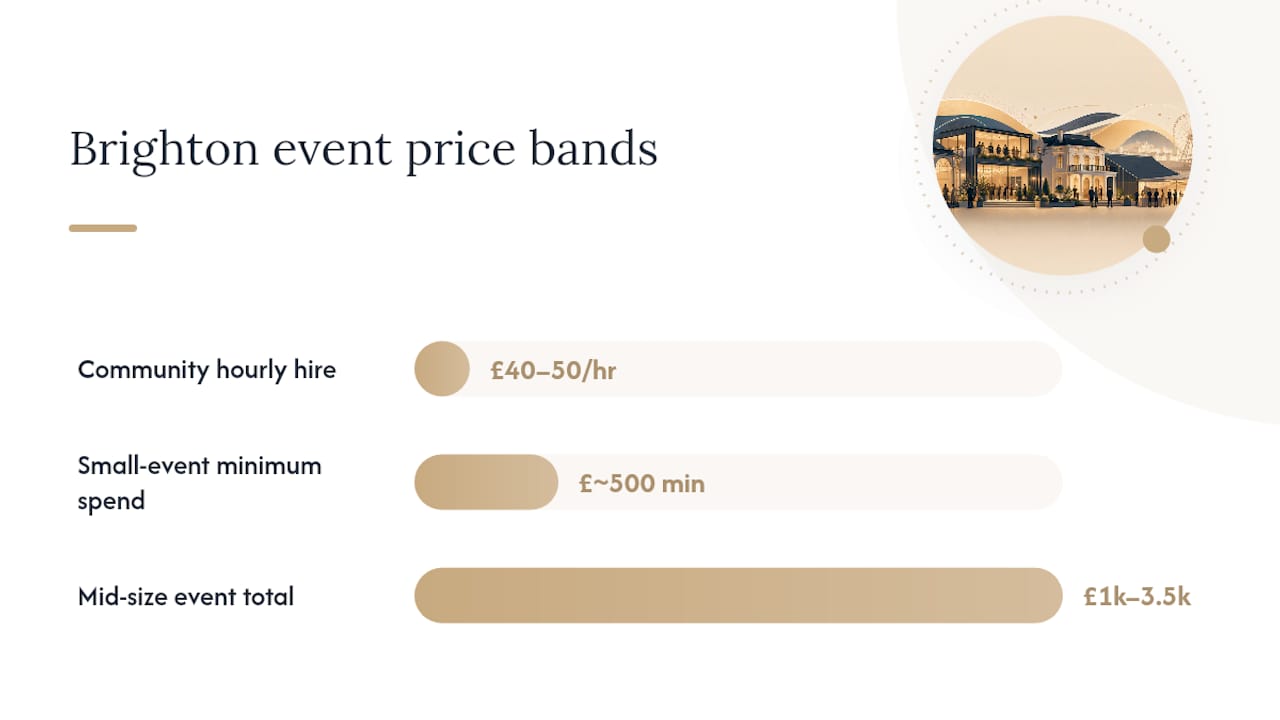
Mid-size events (60 to 150 guests) push costs up because catering, dedicated staff, and basic AV stop being optional. Expect £1,000 to £3,500 as a working band, with the top end driven by Saturday evenings and full-service catering.
Large events (150-plus guests) cost more for structural reasons: extra staff, security, extended access for setup and breakdown, and often exclusive-use fees. Hotel venues in Brighton frequently price this tier per person rather than as a flat fee.
Across every size band, the same rule holds:
- Weekday and daytime slots are consistently cheaper than Friday or Saturday evenings.
- Winter and early spring dates undercut summer and festival-season pricing.
- Shorter access windows (arrive, event, leave within a few hours) cost less than all-day exclusive hire.
Pricing models explained (hire fee, minimum spend, per-head, hybrid)
Brighton venues generally price events using one of four models, and knowing which one you’re being quoted changes how you negotiate. UK venues commonly rely on fixed hire fees, minimum spends, per-head rates, and hybrid structures, and peak dates push all four upward.
- Fixed hire fee: a flat rate for the room, by the hour or the day. Catering and drinks are separate.
- Minimum spend: no hire fee, but you agree to spend a set amount on food and drink. Undershoot it and you pay the difference anyway.
- Per-head rate: one price covers space plus catering, common at hotels and larger function venues.
- Hybrid: a smaller base fee plus a minimum spend threshold, giving the venue a guaranteed baseline either way.
The same 80-guest party could cost noticeably different amounts depending which model applies. A minimum spend of £600 might be easy to hit with a decent bar tab, while a per-head rate of £35 a head hits £2,800 before anyone’s ordered a drink.
Pro Tip: Ask which model applies before you ask for a price. “What’s the minimum spend?” gets a very different answer to “what’s the per-head rate?”, and venues don’t always volunteer which one they’re quoting.
What a venue hire fee usually includes, and the extras to always check
Most Brighton venues bundle the same basics into a standard hire fee: the room itself, basic tables and chairs, standard Wi-Fi, and a baseline clean before and after your event. Access times, typically a window either side of the event for setup and breakdown, are usually specified too.
What gets billed separately is where budgets go wrong. Venue hire quotes often omit costs that only surface later, so ask about each of these before you sign anything:
- Catering and bar service, whether in-house or via an approved supplier list.
- AV beyond the basics, including projectors, microphones, and a technician to run them.
- Extra staff, such as security for larger gatherings or additional bar staff during busy periods.
- Parking, particularly relevant for seafront and central Brighton venues with limited on-site space.
- Damage or refundable deposits, held separately from the hire fee itself.
- Overtime charges if your event runs past the agreed finish time.
- External supplier access fees, charged when you bring your own caterer rather than using the venue’s list.
Organisers frequently underestimate mandatory staff or technician fees specifically, which is the single most common reason a “great value” quote balloons by the time the invoice arrives. If a quote looks unusually low against similar venues, that’s the first place to look.
How to compare quotes properly using total cost per head
Comparing venue quotes side by side only works if you convert every one of them into the same unit. Industry guidance is consistent on this: divide the final all-in total by expected guest numbers to get a genuinely comparable per-head figure, rather than eyeballing headline hire fees against each other.
- Request an itemised quote first. Confirm explicitly whether the figure includes VAT and any service charge, because a quote that looks cheaper can simply be excluding both.
- Add every mandatory extra to the headline number. Staffing, cleaning, and minimum catering spend all belong in this total, not treated as afterthoughts.
- Factor in likely supplier costs. An AV technician or external caterer access fee rarely appears on the first quote but almost always shows up eventually.
- Divide the complete total by your expected guest count. That final per-head number is what you actually compare across venues, not the hire fee alone.
A useful trick from event planners: ask each venue for two quotes rather than one, a bare hire-only figure and a fully itemised all-in figure for the identical guest count and schedule. Requesting both exposes exactly where the cost difference sits and where there’s room to negotiate.
On negotiation, three levers move the needle more than any others: shifting to an off-peak date, using the venue’s in-house catering rather than an external supplier (which often removes an access fee entirely), and keeping your start and finish times flexible rather than insisting on a fixed evening slot.
Pro Tip: Save every quote in the same simple spreadsheet: hire fee, minimum spend, extras, and final per-head figure. Venues rarely present costs the same way, so building your own comparison format is the only way to stop conflicting quote formats confusing the decision.
Brighton’s pricing calendar shows clear peaks during popular events like Brighton Festival and Fringe in May, as well as general summer season increases, making advance booking important during these times.
The local market breaks roughly into a few categories: seafront attractions commanding premium rates for the view, hotels working per-head or hire-fee tiers, bars and restaurants offering flexible minimum-spend deals, and community halls running simple hourly pricing. Minimum spend and hire-fee patterns vary noticeably by venue type across these categories.
Lost And Found Taproom sits in that flexible, transparent bracket. It suits weekday and daytime bookings particularly well:
- Minimum spend rather than a hidden hire fee, so the number you’re quoted is the number you pay.
- An accessible Fiveways location away from seafront premium pricing.
- Full food and beer menus available online before you commit to anything.
Typical contract terms and cancellation policies affecting cost
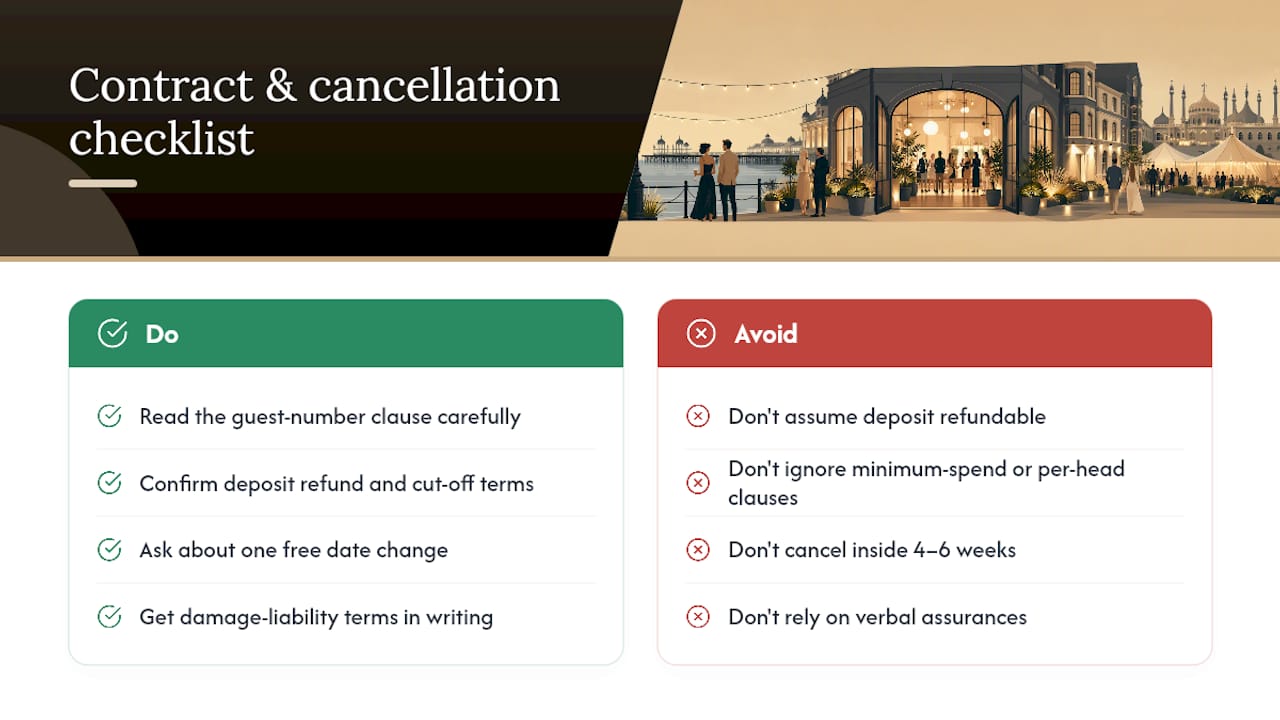
Most Brighton venue contracts follow a similar shape: a signed agreement confirming the date, guest numbers, access times, and total cost, backed by a deposit to secure the booking. That deposit is usually non-refundable if you cancel, though the exact cut-off point varies by venue.
Cancellation policies typically work on a sliding scale. Cancel with several months’ notice and you might lose only the deposit. Cancel inside four to six weeks of the event and many venues charge a much larger percentage of the total, sometimes the full amount, because they’ve likely turned away other bookings for that date.
Read the guest number clause carefully. Contracts for minimum-spend or per-head venues often lock in a minimum guest count, meaning you pay for that number even if fewer people turn up. Some also include a cap, charging extra per head above an agreed maximum.
Force majeure and date-change clauses matter more than most organisers realise. Ask specifically whether you can move your date once, without losing your deposit, if circumstances change. Not every venue offers this, and it’s a reasonable thing to negotiate before signing rather than after.
Finally, check who’s liable for damage. Some venues fold this into a refundable deposit returned within a set number of days after the event; others simply invoice separately if anything is broken. Get this in writing rather than relying on a verbal assurance, because verbal terms are the first thing forgotten in a dispute.
Payment schedules and accepted payment methods
A typical Brighton venue payment structure runs in two or three stages. A deposit, often 20% to 50% of the estimated total, secures the date and is usually due immediately on booking. The balance is then due either a set number of weeks before the event or, less commonly, on the day itself.
For minimum-spend bookings specifically, expect the venue to true up the bill after the event, charging any shortfall between what you actually spent and the agreed minimum. Budget for this rather than being caught out by a final invoice.
Most Brighton venues accept bank transfer as standard, with card payments increasingly common for deposits taken online at the time of enquiry. Cash is rarely the default for anything beyond a small community hall booking. Always ask whether the quoted figure is VAT inclusive, since a venue quoting a net figure can add 20% at invoice stage if you haven’t clarified this upfront.
Larger bookings sometimes allow a staged payment plan, splitting the balance into two or three instalments in the run-up to the event. This isn’t universal, so ask rather than assume it’s available, particularly if you’re managing cash flow for a business event or a large private party.
Cost comparison with alternative event locations nearby
Brighton’s seafront venues and boutique hotels command premium rates for the location and the view, which is reasonable given demand, but it means a straightforward 80-guest gathering can cost considerably more there than the equivalent event a mile inland. Function rooms attached to bars and restaurants tend to sit in the middle, often working on minimum spend rather than a separate hire fee, which keeps costs predictable if your group drinks and eats at a reasonable rate anyway.
Community venues and clubs remain the cheapest route for informal or budget-conscious events, trading exclusivity and polish for a genuinely low hourly rate. Hotel banqueting suites sit at the other end, generally justified by full-service catering and event coordination bundled into the per-head price rather than left for you to organise separately. If you’re weighing up whether a hotel ballroom or a more relaxed local venue fits your event better, a comparison of banquet halls against standard event venues is worth a read before you commit either way.
Taprooms and independent bars, Lost And Found Taproom among them, occupy a useful middle ground for smaller and mid-week bookings: no separate hire fee, a minimum spend that’s genuinely achievable, and none of the per-head markup that hotel catering carries. The trade-off, as with any minimum-spend venue, is less exclusivity and a shorter access window than a full hotel hire gives you.
Timeline overview from inquiry to booking to event date
The realistic window from first enquiry to signed booking runs anywhere from a few days to several weeks, depending on how quickly you can confirm numbers and budget. Popular Brighton weekend dates during festival season or summer get booked out three to six months ahead, so starting early isn’t optional if your date is fixed.
A typical sequence looks like this: enquiry and initial availability check, a follow-up call or viewing to discuss requirements, a formal itemised quote, deposit payment to secure the date, a pre-event planning call four to six weeks out to confirm final numbers and timings, and the balance payment shortly before the event itself.
Build in buffer time at each stage. Venues juggling multiple enquiries for the same weekend won’t hold a date indefinitely without a deposit, and a “we’ll get back to you” gap of even a week can mean losing a preferred Saturday to another booking. For weekday or off-peak events, that pressure eases considerably, sometimes giving you flexibility right up to a few weeks out.
Lost And Found’s view on fair pricing and transparent quotes
Too many organisers get quoted a headline number that bears no resemblance to what they actually pay once staffing, AV, and “optional extras” land on the final invoice. That’s not a pricing model, it’s a guessing game dressed up as one.
Lost And Found Taproom’s approach is deliberately plain: a minimum spend, not a hidden hire fee, with menus published online so nobody’s negotiating blind. Community focus isn’t a marketing line here, it’s the reason weekday and daytime bookings get straightforward pricing rather than premium seafront markups. Transparency should be the baseline expectation for anyone hiring a venue in West Sussex, not a feature worth advertising.
— Author
How to book Lost And Found for your event
Lost And Found Taproom is the practical alternative to chasing hotel per-head quotes or seafront hire fees for a Brighton event: no separate venue charge, a minimum spend that’s genuinely reachable, and full pricing visible before you even make an enquiry.
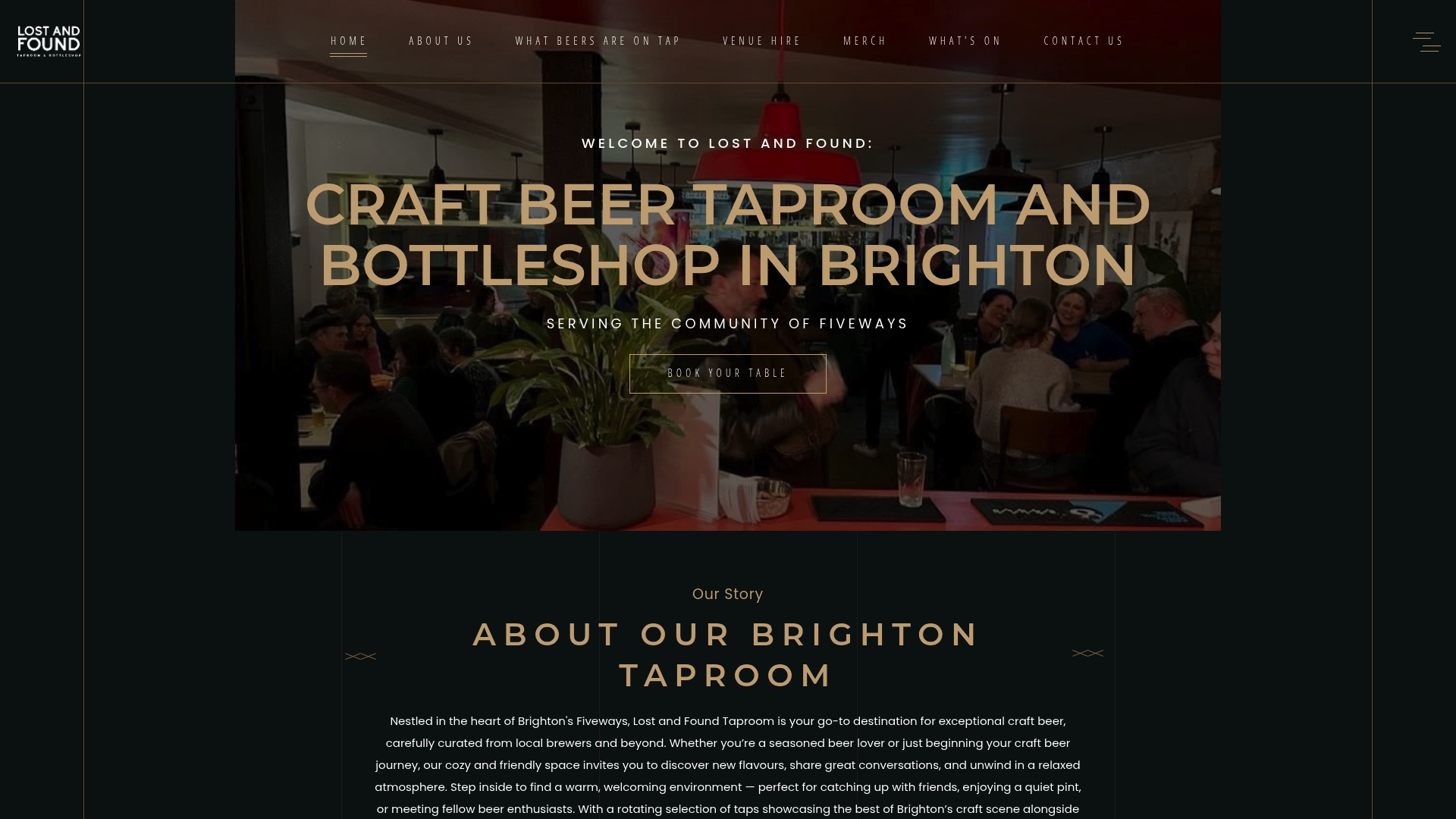
Weekday and daytime bookings often qualify for a no-venue-fee arrangement, provided the minimum spend on food and drink is met, which for a modest gathering usually means covering the bar tab rather than stretching for an artificial threshold. Everything you’d want to check before booking, the beer menu, food offering, and typical drinks pricing, sits online rather than behind an enquiry form. Full detail on how the no-venue-fee model works is worth reading before you reach out.
To move forward: check date availability, request an itemised quote confirming what’s included and what counts toward minimum spend, and confirm any deposit terms before you commit. Start by visiting the venue hire page to see current availability and get the conversation moving.
Sources
The price bands and checklist above draw on Match My Venue’s breakdown of hidden venue costs, Town Hall Spaces’ guide to standard inclusions, Tagvenue’s Brighton minimum-spend data, and Bridebook’s cost-per-head comparison method. Each one grounds a specific figure or framework used throughout this guide rather than a general assumption.
- The hidden costs of venue hire (Match My Venue)
- What’s included in venue hire? (Town Hall Spaces)
- Minimum spend venues in Brighton (Tagvenue)
Recommended
- Free Venue Hire in Brighton: How to Trust Us to Help You Throw an Unforgettable Party at Lost and Found Taproom, Fiveways
- Are Venue Hire Fees Dead? Do People Still Pay to Party in Brighton?
- Venue Hire in Brighton Secrets Revealed: Why You Should Never Pay a Booking Fee Again
- Don’t Miss Out: Why You Need to Book Your Brighton Party Venue ASAP!