Takeaway Alcohol Rules in the UK: What Applies to Take-Home Drinks

A venue can only sell alcohol to take away if its licence allows off-sales, and it must follow that licence’s hours and age-check conditions. There is no general UK rule that takeaway alcohol must come with food. The pandemic-era permission that let pubs sell takeaway pints without a specific licence ended on 31 March 2025. This guide covers England and Wales, where the Licensing Act 2003 applies. Scotland and Northern Ireland have their own licensing systems.
We run a craft beer taproom and bottle shop in Brighton’s Fiveways, so take-home drinks are part of our day. Here is what the rules mean for you as a customer, and for you if you are planning an event.
TL;DR
- Selling alcohol to take away is a licensable activity. The venue needs a premises licence (or another authorisation) that covers off-sales.
- The temporary rule that treated on-sales-only licences as covering takeaways ran out on 31 March 2025. It was not made permanent.
- Hours, age checks and other conditions on the licence apply to takeaway, collection and delivery sales too.
- There is no blanket UK rule that takeaway alcohol must be bought with food. Any such limit comes from a specific licence.
- The “20-minute rule” is old drinking-up time. It is not a statutory rule under today’s Licensing Act.
Table of Contents
- What counts as takeaway alcohol
- What a business needs to sell alcohol to take away
- What changed on 31 March 2025
- Hours, collection and delivery
- Does takeaway alcohol have to come with food?
- Age checks when you buy or collect
- The 20-minute rule
- Drinking your takeaway: rules outside the venue
- Planning an event: what to sort out first
- Our view on take-home drinks
- Drinks to take home or hire us for the night
- FAQ
- Sources
What counts as takeaway alcohol
Takeaway alcohol, in licensing terms an “off-sale”, is alcohol sold at a venue for drinking somewhere else. That covers a bottle from a bottle shop, cans bought at a bar, a growler or other container filled to take home, and drinks collected or delivered after an order by phone or website.
The retail sale of alcohol is a licensable activity under the Home Office’s section 182 guidance. Section 182 guidance is the guidance the Home Office issues to licensing authorities on how to apply the Licensing Act 2003. It lists premises licences, club premises certificates, temporary event notices and personal licences as the permissions involved.
For you as a customer, the practical point is simple. A place that sells you a sealed bottle to take home is doing it under a licence that allows it. A place that sells only for drinking on the premises may not be allowed to hand you a drink to walk out with.
What a business needs to sell alcohol to take away
According to GOV.UK’s alcohol licensing guidance, a business that sells alcohol permanently needs a premises licence or another applicable authorisation from its local licensing authority. That is normally the district or borough council, or in Brighton and Hove the city council. Occasional activity can instead be covered by a Temporary Event Notice where the seller is eligible.
Three pieces fit together:
- The premises licence. It lists the licensable activities, such as sale of alcohol on the premises, off the premises, or both, and the hours for each.
- A named Designated Premises Supervisor. The same GOV.UK guidance says a premises licence authorising alcohol sales normally needs a Designated Premises Supervisor who holds a personal licence, subject to a statutory exception for community premises.
- Conditions. These are mandatory national conditions plus any the council adds for the local area.
The law treats unlicensed selling seriously. The official explanatory notes to the Licensing Act 2003 say it is an offence to carry on, or knowingly allow, a licensable activity without the required premises licence, club premises certificate or Temporary Event Notice. Courts may also order confiscation of alcohol exposed or kept for unauthorised sale.
Where online and phone orders fit
The same Home Office guidance says an order-taking call centre need not itself be licensed if it does not appropriate the alcohol, but the warehouse that selects and dispatches the order does need a licence. In plain terms, the licence follows the place the alcohol is sold from.
What changed on 31 March 2025
During the pandemic, the Business and Planning Act 2020 temporarily treated eligible on-sales-only premises licences as authorising off-sales until 31 March 2025. That is why takeaway pints, pouches and cartons of beer from pubs became familiar.
In 2023 the government decided against making that permanent. Its consultation outcome confirmed it extended the easement only until 31 March 2025, not as a blanket permission.
What that means today:
- A venue whose licence includes off-sales can still sell takeaway drinks as before.
- A venue whose licence covers only drinking on the premises needs its licence varied by the council to sell takeaway.
- Old search results about takeaway pints during lockdowns describe rules that no longer apply.
If a venue does not offer takeaway pints now, this is usually why. It is a licence question, not a matter of preference.
Hours, collection and delivery
Takeaway sales do not escape the licence’s opening and sales hours. The Home Office’s September 2026 guidance states that licence conditions, including the authorised alcohol-sale hours and the mandatory conditions, apply to remote and delivery sales at the licensed premises.
Councils spell this out for delivery. Eastleigh Borough Council’s alcohol delivery guidance says sales must be within licence hours, and that online or telephone ordering must stop at the alcohol-sales cut-off time. Other councils may word it differently, so the licence itself is the document that counts.
For a customer, this means an order placed after a venue’s off-sales cut-off can be refused, even if the kitchen or bar is still open.
Does takeaway alcohol have to come with food?
No general UK rule says so. The Home Office guidance makes no general requirement that takeaway or delivered alcohol must be sold with food. Any such restriction depends on the conditions on the individual licence or local authorisation.
The food rule most people remember came from lockdown. In November 2020 the government said drinks could be taken away from a venue if they were pre-ordered, and some pages still ranking for this topic are from that period. They describe temporary emergency rules, not the position now.
Some licences do carry a condition tying takeaway alcohol to a food order. That is a local decision, usually for a takeaway restaurant. If you are ordering from a restaurant or delivery service, the seller will know whether its licence has such a condition. Rules on what can be sold also vary by category of goods, as a prohibited items list shows for general local selling.
Bringing food into a pub is a separate question, covered in our guide to outside food in pubs.
Age checks when you buy or collect
The legal age to buy alcohol is 18. Sellers must have a way of proving that they check, and the mandatory licence conditions require it.
Stroud District Council’s mandatory-conditions document, updated in October 2026, says premises must adopt an age-verification policy, make sure staff know it, and have the Designated Premises Supervisor ensure it is followed. Its recommended approach is Challenge 25, which means asking for ID from anyone who looks under 25. Many venues use the same approach.
For orders by phone or website, Eastleigh’s guidance recommends checking age both when the order is placed and at delivery. It says an order should be declined if verification cannot be completed.

There is also a separate offence of knowingly delivering alcohol to a child. The explanatory notes to the Act say this covers someone working on the premises, including knowingly allowing another person to make such a delivery.
Digital ID is coming into the picture
On 17 November 2026 the government published an announcement on digital proof of age for alcohol. It describes a service that confirms a customer has reached the required age and that a registered provider has verified their identity to at least medium confidence.
A draft 2026 amendment to the mandatory conditions would go further. Under the draft Licensing Act 2003 (Mandatory Licensing Conditions) amendment, an age-verification policy could accept digital ID only if the responsible person is covered by an agreement with a registered digital identity provider. Because it is a draft, check the current position with your licensing authority before relying on it. For now, carry a physical ID such as a passport or photocard driving licence if you might be asked.
The 20-minute rule
People often ask about a “20-minute rule” for alcohol. It refers to drinking-up time: for many years, ten minutes and later twenty minutes was the dispensation that let customers keep drinking after the official closing time, as the history of UK licensing law describes.
The Licensing Act 2003 changed that. Opening hours and sales hours are no longer fixed in statute but are set individually in the conditions on each premises licence. So today:
- There is no single national drinking-up period you can count on.
- Any grace period at closing time is the venue’s own policy or a licence condition.
- The only dependable times are the ones on the venue’s licence.
The practical advice is to buy your last drink or bottle before the venue’s last-orders time and not rely on any extra minutes.
Drinking your takeaway: rules outside the venue
Buying takeaway alcohol is one thing and where you open it is another. Licensing covers the sale. Councils can also use Public Spaces Protection Orders to restrict drinking in particular outdoor areas. Brighton and Hove has a Consumption of Alcohol Public Spaces Protection Order, and the council page sets out the areas it covers and what it allows. If you plan to take bottles to the seafront or a park, read it first.
Carrying a sealed bottle home from a bottle shop is a different matter from drinking in a restricted area. The safe habit is to keep it sealed until you are somewhere you are allowed to drink it.
For how much you are drinking, our guide to alcohol units in the UK shows how quickly a strong craft pint adds up. If children are with you, see children in pubs in the UK for what the law says.
Planning an event: what to sort out first
If you are planning a party, a stag do or a gathering in Brighton, the licensing question is who is selling the alcohol and under what authority. Hiring a licensed venue means the venue’s licence and its conditions cover the bar. You do not need to apply for anything yourself, but you do need to work within the venue’s hours and age-check policy.
A Temporary Event Notice is for people who want to sell alcohol at an event in a place that has no licence for it. For a party in a licensed taproom you do not need one.
What to ask any venue before you book:
- What hours does the licence allow for alcohol sales on the day?
- Is the bar run by the venue, and does a minimum bar spend apply?
- Can guests take drinks away at the end of the night, or only bottles bought from the shop?
- How are ages checked for guests, including younger people at a family-style event?
- Is food arranged by the venue, a street food van or guests?
Our private party planning checklist walks through the rest, and how much beer to order for 50 guests gives sample quantities. For food, see street food catering at venues.
Our view on take-home drinks
Take-home drinks should be a pleasure, not a legal puzzle. We keep a bottle shop alongside the taproom so that a beer you try on tap can go home with you, and so that a friend who could not make it gets something from the same Sussex producers.
Every beer and cider we serve comes from independent Sussex breweries, and we curate wines to sit alongside them. That focus is why people come to us to try something new rather than the same national brands. Our food and beer menus are online, so you can see what is on before you set out.
For parties, our venue hire gives you exclusive use with no hire fee, with a minimum bar spend. You choose the decorations, music and drinks, and the bar runs in line with the premises’ licensing conditions, so you can enjoy the night and leave the rules to us.
Lost And Found Taproom
Drinks to take home or hire us for the night
If you want to try Sussex beer, cider or English wine and take some home, see what we pour and stock on our On Tap page. Our bottle shop sits alongside the taproom, so you can drink in and take home from the same visit.
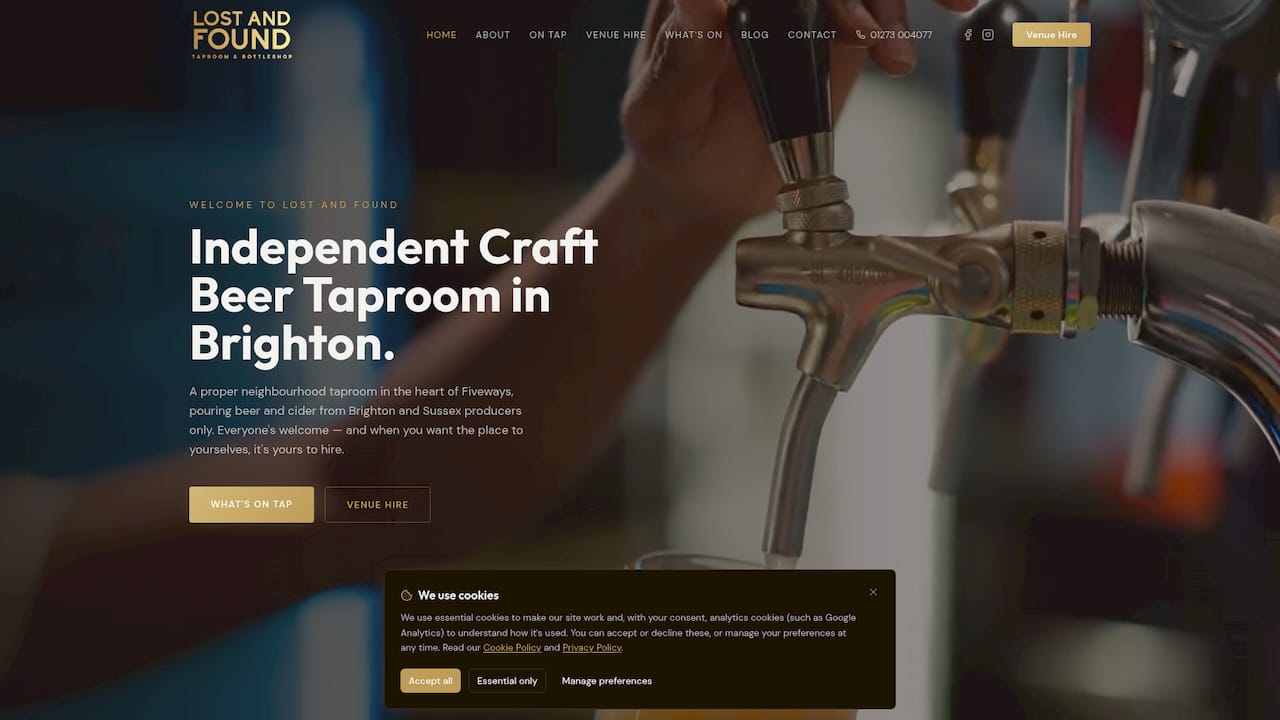
If you are planning a party or a stag do in Brighton, our venue hire page covers midweek and weekend hire, with exclusive use and no hire fee.
FAQ
Can a pub sell takeaway pints in the UK now?
Only if its premises licence covers off-sales. The temporary permission that let on-sales-only venues sell takeaway ended on 31 March 2025. Venues without off-sales on their licence need the council to vary it first.
Do I have to buy food to take alcohol away?
No general UK rule says you must. Any food condition comes from the individual premises licence or local authorisation, and sellers will know whether theirs has one. Wartime-style lockdown rules from 2020 and 2021 no longer apply.
Is there a legal 20-minute drinking-up time?
No. The 20 minutes came from older licensing law. Under the Licensing Act 2003, hours are set on each premises licence, so any extra time at closing is the venue’s own policy.
What ID do I need to buy alcohol to take away?
You must be 18 or over, and many venues ask for ID from anyone who looks under 25 under a Challenge 25 policy. A passport or photocard driving licence is the safest to carry. Digital ID for alcohol is being developed, but check the venue’s policy before relying on it.
What happens if a business sells alcohol without a licence?
It is an offence under the Licensing Act 2003 to carry on or knowingly allow a licensable activity without the required authorisation. Courts can also order the alcohol to be confiscated.
Sources
- Alcohol licensing, GOV.UK
- Revised guidance issued under section 182 of the Licensing Act 2003
- Licensing Act 2003 explanatory notes
- Business and Planning Act 2020, section 11
- Licensing Act 2003 regulatory easements consultation outcome
- Eastleigh Borough Council alcohol delivery service guidance
- Stroud District Council mandatory conditions for off-sales
- Digital proof of age for alcohol, 17 November 2026
- Draft Mandatory Licensing Conditions amendment 2026
- Alcohol licensing laws of the United Kingdom
- Brighton and Hove Consumption of Alcohol Public Spaces Protection Order
- Prohibited items list