Sustainable Breweries in the UK: What Counts and Where to Taste It

A sustainable brewery is one that measures where its footprint comes from and cuts it at the source: grain, boiling and cleaning energy, water, packaging and transport. For a drinker, the simplest way to back that work is to drink beer brewed close to where you pour it, ideally on tap. At Lost And Found Taproom in Brighton’s Fiveways, every beer and cider we serve is produced by independent Sussex breweries, so the miles between brewery and glass stay short.
This guide explains where a beer’s footprint really sits, which UK breweries are doing measurable work, how to tell results from marketing, and how to taste the difference locally.
TL;DR
- Ingredients, brewing energy, packaging and distribution are the four big sources of a beer’s footprint, and each has a different fix.
- Water, renewable power and reusing waste (grain, yeast, wastewater) are where UK brewers are reporting real numbers.
- Be wary of vague green claims. Look for figures, a time period and a baseline.
- Drinking local beer on tap, ideally in a taproom, is one of the simplest low-footprint choices a drinker can make.
- Every beer and cider at Lost And Found comes from independent Sussex breweries, and our menus are online.
Table of Contents
- Where a beer’s footprint comes from
- Water: the quiet big lever
- Energy and circular brewing
- Packaging and transport: where you have a say
- How to spot greenwashing
- Why a local pint on tap is a sound choice
- Sussex beers worth trying
- Our view
- Taste it at Lost And Found
- FAQ
- Sources
Where a beer’s footprint comes from
Before judging any brewery, it helps to know what actually drives the footprint of a pint. CAMRA’s What’s Brewing sets out the split in useful terms:
| Stage | Share of a beer’s footprint | What drives it |
|---|---|---|
| Brewing materials | 20 to 30% | Mostly barley, which accounts for around three-quarters of the CO2 in this stage |
| Brewing operations | About 12% | Electricity for pumps and controls, gas for boiling wort and cleaning |
| Packaging | 5 to 45% | Depends heavily on the type of pack |
| Distribution and retail | About 15% | Transport miles and cooling |
The same piece notes that casks and kegs perform better than bottles and cans. That is a useful rule of thumb when you stand at a bar: a beer poured from a keg or cask has skipped the heaviest packaging stage.
It also explains why “sustainable” means different things at different breweries. One brewer may focus on grain sourcing, another on solar panels, another on how its beer travels. None of these is a complete answer alone, which is why the numbers matter.
Water: the quiet big lever
Brewing is thirsty. Lucy Britner’s August 2026 report in Drinks Retailing says traditional breweries have used 4 to 8 pints of water for every pint of beer. The same article reports that Northern Monk in Leeds has cut its water use by 28%, and that AB InBev’s Magor brewery in South Wales achieved a 60% reduction in onsite water use.
Smaller independents are working on this too. The trade body SIBA, which represents independent brewers, identifies water as a key area in its net zero report and says some member breweries report usage down to 1.5 pints per pint brewed.

When a brewery quotes a water figure, check that it is a ratio (water per unit of beer), not just a total. A big brewery can use more water in total and still be more efficient per pint.
Energy and circular brewing
Heating wort to the boil and cleaning vessels are the energy-hungry parts of the process. Britner’s piece describes energy efficiency in mashing and wort boiling as one of brewing’s greatest opportunities. Brewers tackle it with heat recovery, more efficient boilers, on-site solar and renewable electricity contracts.
The most striking example from our own corner of the country is in Sussex. Hepworth Brewery’s wastewater-to-energy system treats up to 17 cubic metres of brewery wastewater a day. It generates 362 MWh of renewable energy a year and saves over 100 tonnes of CO2 annually. The treated water is returned to local ecosystems and the leftover digestate becomes organic fertiliser. That is circular brewing in the plainest sense: what used to be a waste stream powers the next batch.

The Brewers Journal reports on Hepworth’s Nexus series, which is brewed with energy from that system, using local hops and organic barley from Sussex. The range includes Liquid Asset lager, Electric Hop IPA and Botanic State, a 0.5% pale ale.
Other routes to the same goal include:
- Spent grain to farms. The leftover malt is a nutritious animal feed, so it rarely needs to go to waste.
- Heat recovery. Capturing heat from hot wort to pre-warm the next brew cuts gas use.
- On-site solar. Brewers with roof space can offset a good part of their electricity draw, though output drops in darker months.
- Reused CO2 and water. Capturing fermentation CO2 and recycling rinse water both reduce what a brewery buys in.
Packaging and transport: where you have a say
Packaging can swing from 5% to 45% of a beer’s footprint depending on the format, according to the CAMRA figures above. Glass is heavy to make and to move, which is why draught beer tends to come out ahead. If you want to see how packaging choices play out in another sector, this overview of sustainable packaging benefits explains the logic of lighter, recyclable materials clearly.
Transport is the other lever. CAMRA’s advice to drinkers is blunt: the simplest choices are drinking local beers in brewery taprooms, favouring distribution that cuts transport miles, and keeping cooling energy down. That puts part of the roughly 15% distribution share in the drinker’s own hands. A beer made in Sussex and poured in Brighton travels a short road before it reaches you.
How to spot greenwashing
Drinks Retailing reports growing concern about greenwashing, with consumers and trade buyers more sceptical of vague claims that are not backed by measurable data. A few habits make it easy to separate the real from the decorative:
- Look for numbers with a period. “Cut water use by 28%” tells you something. “Committed to the planet” does not.
- Ask what the baseline is. A 20% cut from which year, and measured how?
- Separate results from targets. A target for 2030 is a plan. A figure reported for last year is a result. Good reports label both.
- Prefer cuts to credits. Reducing energy, water and waste at the brewery is a different thing from paying for offsets elsewhere.
- Check the whole chain. Grain, packaging and delivery all count, not just the brewhouse.
- Notice who verifies it. Independent assessment or a published report with methodology carries more weight than a label on a can.
A brewery that publishes a report with figures you can read is doing the hard part. One that only uses a green leaf logo has not told you much.
Why a local pint on tap is a sound choice
Putting the figures together, a locally brewed beer served on draught addresses two of the larger stages at once: it avoids much of the packaging stage and it shortens the journey. It also keeps money inside the local brewing economy. Independent Sussex brewers are the ones doing the farm-to-glass work: growing or sourcing barley and hops regionally, sending grain to nearby farms and running leaner kit.
This is the reason we built our taproom around them. If you want the story behind the producers, our guide to Brighton’s independent breweries introduces the people behind each pour, and why independent Sussex breweries matter explains what they add to the local scene.
Sussex beers worth trying
You do not need to travel far to taste what small-scale, locally minded brewing looks like. A few ways in:
- Pale ales with a sense of place. The Sussex Express reported in August 2026 on Long Man’s Seven Sisters Pale Ale, a light, easy-drinking beer with stone fruit and citrus notes from Mosaic and Citra hops, named after the Eastbourne-to-Seaford cliffs.
- Low and no styles. Lower-strength beers such as the 0.5% pale ale in Hepworth’s Nexus range show that circular brewing does not limit you to a single style.
- Session beers. Lighter, lower-ABV pints suit a long afternoon. Our guide to sessionable craft beer covers what to look for.
- Seasonal pours. Our picks of summer beers from Sussex breweries show how the county’s brewers work with the seasons.
If a day out appeals more, our East Sussex breweries guide maps two day trips for taprooms, tours and events. Beers on tap change as kegs finish, so check what is pouring on our on tap page, where our food and beer menus are available online.
Our view
We run a taproom, not a brewery, so we are careful about what we claim. What we can say is how we choose: every beer and cider we serve is produced in Sussex by independent breweries, and we hold to that strictly.
The footprint figures tell a clear story. Packaging and distribution are big slices, and both shrink when beer is poured from a keg or cask close to where it was made. A taproom is the shortest route from brewery to glass.
We also think sustainability is about community. Independent brewers reinvest locally, buy grain and hops regionally where they can and keep skilled jobs in the county. When you choose a Sussex pint, you back that whole chain.
That is why we keep the selection rotating: different Sussex brewers, different styles, always local. Come in, ask what is new on the taps and let us talk you through it. Bottles to take home are there too, and so are curated wines for anyone who wants a change.
Lost And Found Taproom team
Taste it at Lost And Found
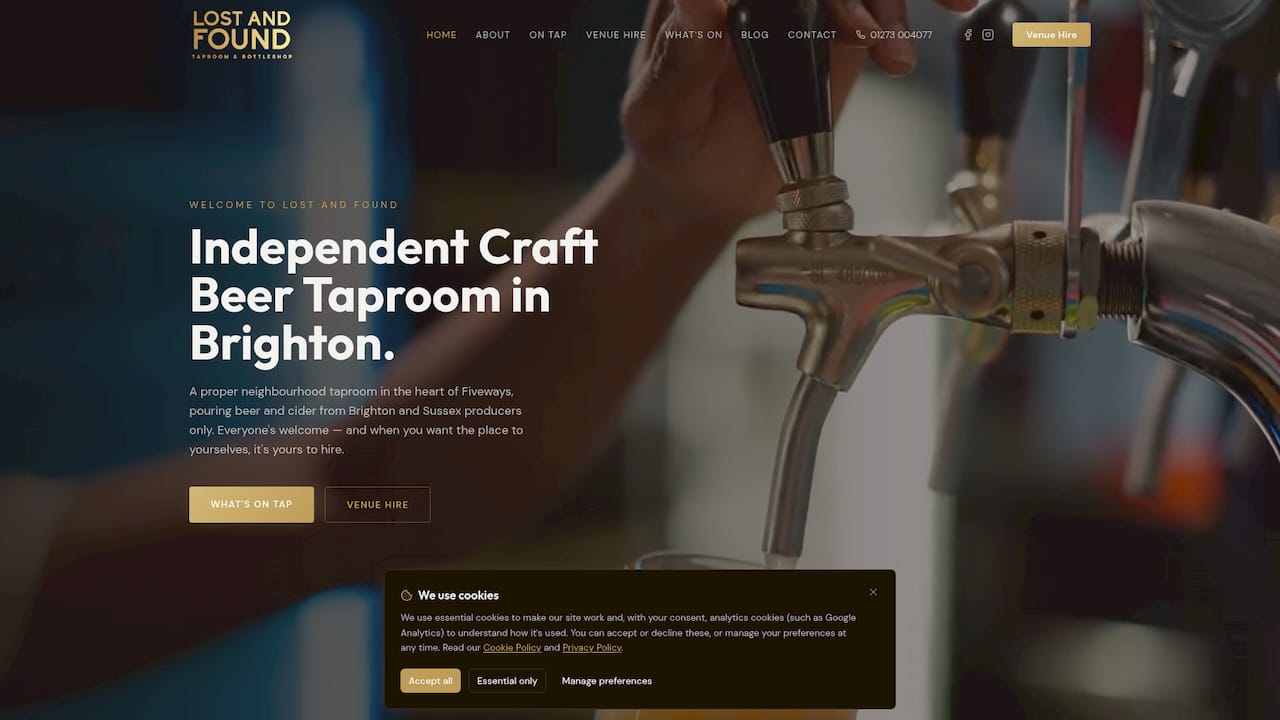
If this article has made you curious, the easiest next step is a pint. Our taproom in Fiveways pours Sussex beer and cider from independent breweries, stocks a bottle shop for taking home and hosts street food vans and XXL hot dogs so you can make an evening of it. You can see the current selection and menus on our on tap page.
Planning a get-together? Our venue hire gives you exclusive use of the taproom with no hire fee, and you choose the decorations, the music and the drinks. Birthdays, stag dos and community evenings all fit. Details of midweek and weekend hire are on our venue hire page.
FAQ
What makes a UK brewery sustainable?
A sustainable brewery measures and reduces its impact across grain, energy, water, packaging and distribution. CAMRA’s figures show materials account for 20 to 30% of a beer’s footprint, operations about 12% and distribution about 15%, so a brewery needs to work on more than one area. Published results with figures are the clearest sign of real progress.
Is draught beer better for the environment than canned or bottled beer?
Often, yes. CAMRA’s What’s Brewing notes that casks and kegs outperform bottles and cans on footprint, and packaging can range from 5% to 45% of a beer’s total. Drinking draught beer locally also cuts transport miles.
How much water does it take to brew a pint?
Drinks Retailing reports that traditional breweries have used 4 to 8 pints of water per pint of beer. Some independent brewers report much lower figures, with SIBA citing members down to 1.5 pints.
Where can I try Sussex-brewed beer in Brighton?
At Lost And Found Taproom in Fiveways, where every beer and cider we serve is produced by independent Sussex breweries. The selection rotates, and our menus are online, so you can see what is on before you come.
Sources
- Consumers lead the way on green beer, What’s Brewing (CAMRA)
- Brewing Our Way to Net Zero (SIBA, 2023)
- Sustainability in UK cider and beer, Drinks Retailing
- Hepworth Brewery installs UK-first circular wastewater-to-energy system, Food & Drink Technology
- Hepworth Brewery in UK first, The Brewers Journal
- New beer named after iconic Sussex landmark, Sussex Express
- Sustainable packaging benefits