Why a 4% Pint Can Be a True Session Beer in the UK
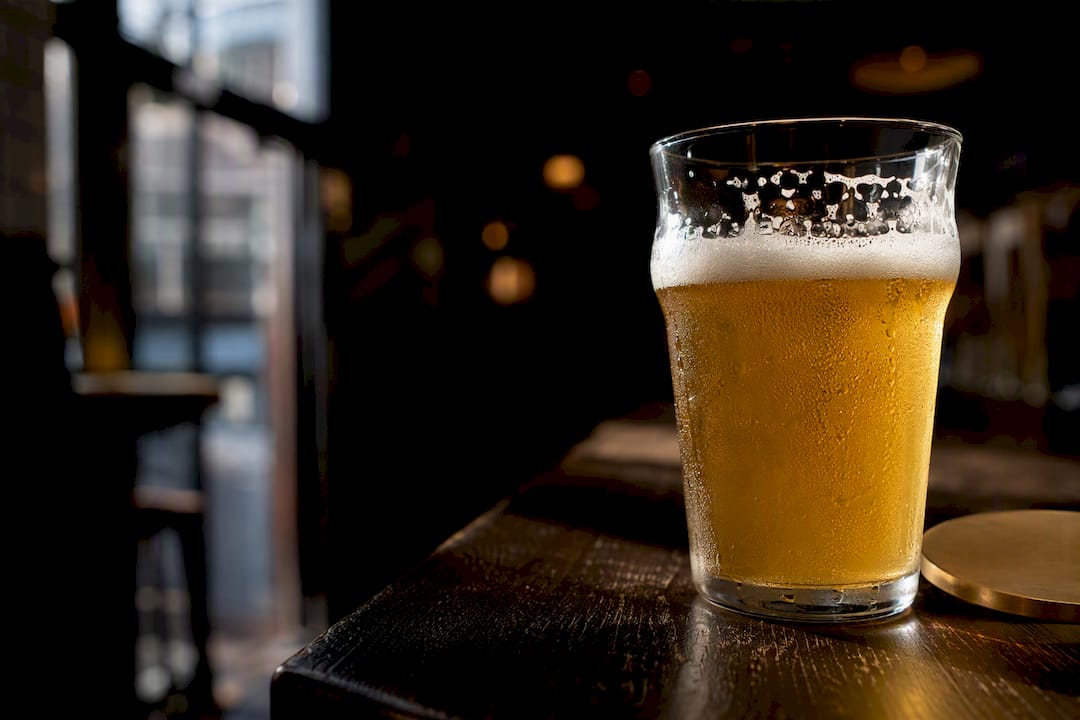
A session beer is a lower-alcohol beer brewed and balanced so you can comfortably enjoy multiple pints, generally with an alcohol by volume (ABV) usually up to about 5%, without losing flavour or feeling overfull. The defining trait isn’t a fixed number or a single style; it’s drinkability, sometimes called “moreishness”, the quality that makes a second and third pint feel just as good as the first.
TL;DR:
- Beers up to 4.5% ABV are generally considered most suitable for session drinking, but some communities accept up to 5%.
- Balanced session beers rely on proportional levels of malt sweetness, hop bitterness, and mouthfeel to maintain flavor at low alcohol content.
- Styles like session IPAs, pale ales, milds, and dry stouts are traditionally built for multiple-drink enjoyment with lower strength and moderate bitterness.
- Brewing a low-ABV beer that tastes full and interesting requires specific techniques such as hop bursting and dextrin malt use to avoid a watery or thin profile.
- “Session” is a flexible category based on how a beer drinks, not fixed by strict ABV, and can include a variety of styles designed for prolonged social drinking.
Table of Contents
- What actually makes a beer sessionable
- Which beer styles count as sessionable
- Why brewing a low-strength beer well is harder than it sounds
- How to spot a session beer in a pub or shop
- Where the term “session beer” actually comes from
- How Lost And Found Taproom thinks about session beers
- The perspective worth remembering on session beer
- Sources
What actually makes a beer sessionable
Session beer describes a category, not a style, and its boundaries shift depending on who you ask. Catalog puts the typical range at 3.0 to 4.5% ABV, though it acknowledges beers up to 5% often get called sessionable too. Allagash takes a similarly loose view, describing session beer as anything generally under 4 to 5% ABV that’s “high in refreshment and not too filling.” Neither source treats the cut-off as a hard line, which is exactly the point: session is about proportion, not a spec sheet.
Three things shape that proportion:
- ABV: usually 3 to 4.5%, occasionally stretched to 5% depending on the community and style guide referenced.
- Bitterness: balanced session beers tend to sit in the 10 to 35 IBU range, with hop intensity scaled down alongside the alcohol so nothing tastes lopsided.
- Mouthfeel: carbonation level and, in some styles, nitrogenation, both influence how “full” a beer feels after the third or fourth glass.
Moreishness comes from getting all three in proportion. Drop the ABV without adjusting the malt and hop bill, and you get something thin and forgettable. Keep the hop rate high while cutting alcohol, and the beer turns aggressively bitter for its strength. The trick brewers are chasing, and the thing your palate actually notices, is a beer where the malt sweetness, hop bitterness and yeast character all shrink together, so the finished pint tastes complete rather than diluted.
Which beer styles count as sessionable
Several established styles were built for exactly this kind of drinking, long before “session” became a marketing word. Here’s what to expect from each:
- Session IPA: usually 3.5 to 4.5% ABV, leaning on hop-forward aroma (citrus, pine, tropical fruit) without the heavy bitterness or body of a full-strength IPA.
- Pale ale: typically 3.8 to 4.5%, balanced malt sweetness against moderate hop bitterness, and a lighter body than an American pale ale.
- Mild: a genuinely old British style, often 3 to 3.8% ABV, malt-led with gentle caramel or nutty notes and very restrained bitterness.
- Dry stout: dark in colour but often light in body, with roasted, coffee-like notes rather than heavy sweetness.
Dry stout is the clearest proof that colour tells you nothing about strength. Guinness Draught, the style’s best-known example, sits around 4.2% ABV with roughly 125 calories a pint, and its nitrogenated pour gives it a famously smooth, low-fizz mouthfeel. That lower carbonation is one reason nitrogenated stouts feel less bloating over several pints than a heavily carbonated lager of similar strength. It looks like a heavyweight and drinks like a session pint.
Why brewing a low-strength beer well is harder than it sounds
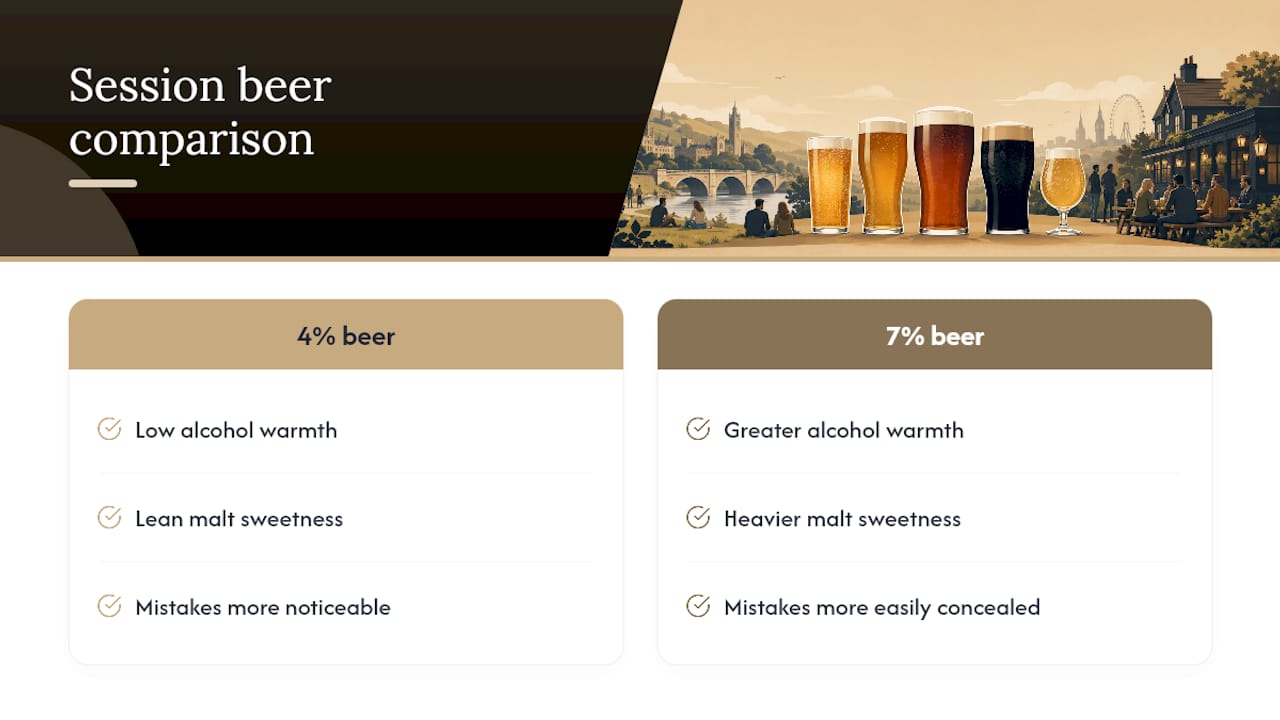
Anyone can drop the alcohol in a beer. Keeping it interesting at 3.8% instead of 6% is a different problem entirely. Lower ABV means less alcohol to mask off-flavours, so every brewing mistake, a stuck fermentation, an unclean yeast strain, an overzealous hop addition, shows up far more obviously than it would in a bigger beer.
Brewers lean on a handful of specific techniques to compensate:
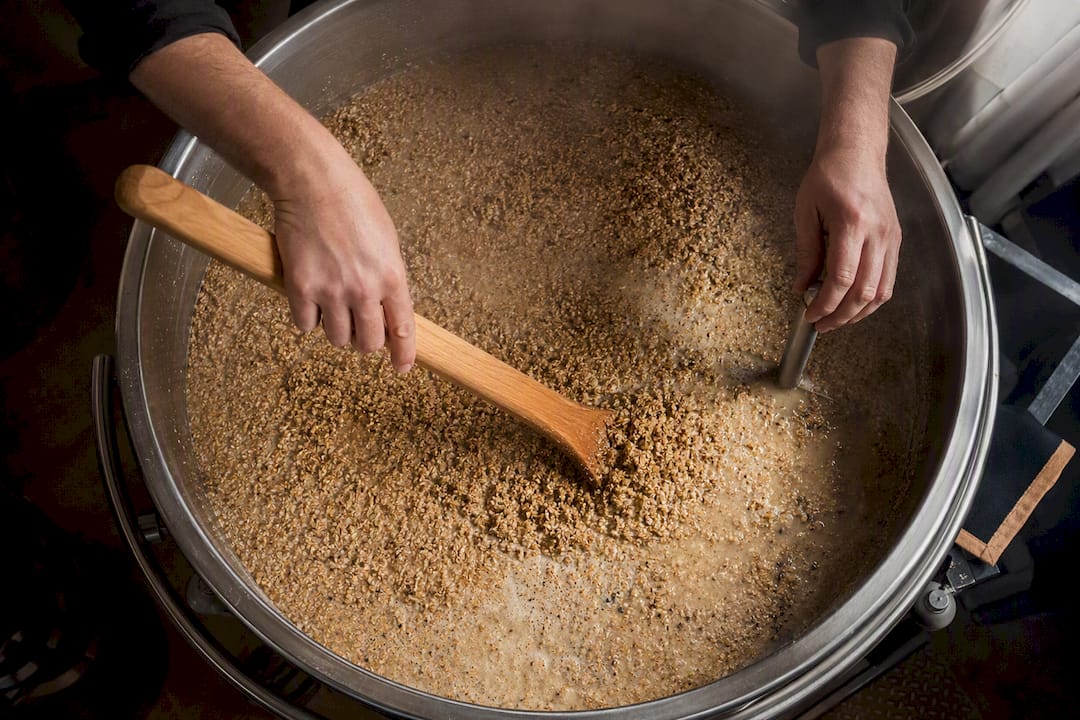
- Hop bursting: adding most of the hops late in the boil or in the whirlpool to build aroma and flavour without dragging in harsh bitterness.
- Dextrin malts: unfermentable sugars that add body and a fuller mouthfeel without raising alcohol.
- Careful yeast selection and attenuation control: choosing strains that leave enough residual sweetness to round out the finish.
- Mash profile adjustments: raising the mash temperature slightly to retain more body-giving sugars.
These levers, original gravity, dextrin malt use and attenuation control, are what a brewer adjusts to chase fullness without reaching for more alcohol. Some breweries also use nitrogenation for a creamier pour that reads as fuller than the ABV suggests.
Pro Tip: If a session beer tastes watery rather than balanced, it’s usually a mash or dextrin problem, not an inherent limitation of low ABV. A well-made 3.8% pale ale should never taste like weak lager.
How to spot a session beer in a pub or shop
You don’t need a brewer’s knowledge to judge sessionability on the spot. A few quick checks do most of the work:
- Check the ABV first. Anything from about 3% to 4.5% is safely in session territory; treat 4.5 to 5% as borderline depending on how the rest of the pint drinks.
- Read the label or menu language. Words like “session”, “table beer” or “mild” are usually deliberate signals, not just marketing filler.
- Take a small sip before committing to a pint. Balance and a light-to-moderate fizz suggest it’ll hold up over multiple rounds; heavy sweetness or aggressive carbonation often won’t.
- Factor in price and pour size. A cheaper, smaller-format pour of something at 4% makes far more sense for an afternoon session than a premium keg beer at 6.5%.
If you want a structured way to run through that first sip, a proper beer tasting approach makes the balance easier to judge than guessing from smell alone.
Where the term “session beer” actually comes from
The phrase has a murkier past than most brewery marketing suggests. One popular theory traces it to British pub culture and, more specifically, to accounts of WWI-era munitions workers drinking lower-strength beer across fixed shift breaks, the “session.” The documentary trail is thin rather than conclusive, but the story fits the logic: beer strong enough to enjoy, weak enough not to end your working day early.
The modern usage owes more to the craft beer revival than to wartime pubs. Writers and brewers, notably through projects like the Session Beer Project, pushed back against the “bigger is better” trend of the 2000s and 2010s, arguing that flavour didn’t need to come from extra alcohol. That advocacy is why session beer now sits comfortably alongside imperial stouts and triple IPAs on modern menus, rather than being dismissed as the weak option. There’s still no single formal definition, and different brewers, competitions and drinkers all draw the ABV line slightly differently.
How Lost And Found Taproom thinks about session beers
We keep a rotating lineup that often includes sessionable beers alongside bigger, bolder pours. By selecting from various independent UK brewers, we include styles such as mild or hop-forward session pales to offer variety for tasting flights or long afternoon visits with friends.
Lower-strength beers are what make tasting flights and social sittings actually work; nobody wants their fourth pour to be their last for the day. Our food and beer menus are available online, so you can check what’s currently pouring before you visit. Have a look at a beer menu to see what’s sessionable this week.
The perspective worth remembering on session beer
Most drinkers still hear “session beer” and assume it means “the weaker, less interesting option,” the thing you order when you’re not really in the mood for a proper beer. That’s backwards, and it’s worth saying plainly: brewing something excellent at 4% is harder than brewing something excellent at 7%, because there’s nowhere to hide a mistake behind alcohol warmth or heavy malt sweetness.
What gets missed in most explainers is that sessionability isn’t really about restraint. It’s about proportion. The best session beers aren’t diluted versions of stronger styles; they’re built from the ground up with every element, malt, hops, yeast, carbonation, scaled to match a lower ABV so nothing feels out of balance. That’s a genuinely different brewing problem, not a simplified one.
The other thing worth pushing back on: there’s no committee that owns the definition. Style guides disagree on whether 5% counts, historians can’t fully prove the wartime origin story, and brewers themselves treat “session” as a design goal rather than a fixed rulebook. That looseness is a feature, not a flaw. It means the category stays useful precisely because it describes how a beer drinks rather than boxing it into a strict number nobody agrees on anyway.
— Author