Use Up to 20 TENs Safely: UK Public Drinking Rules for Taprooms
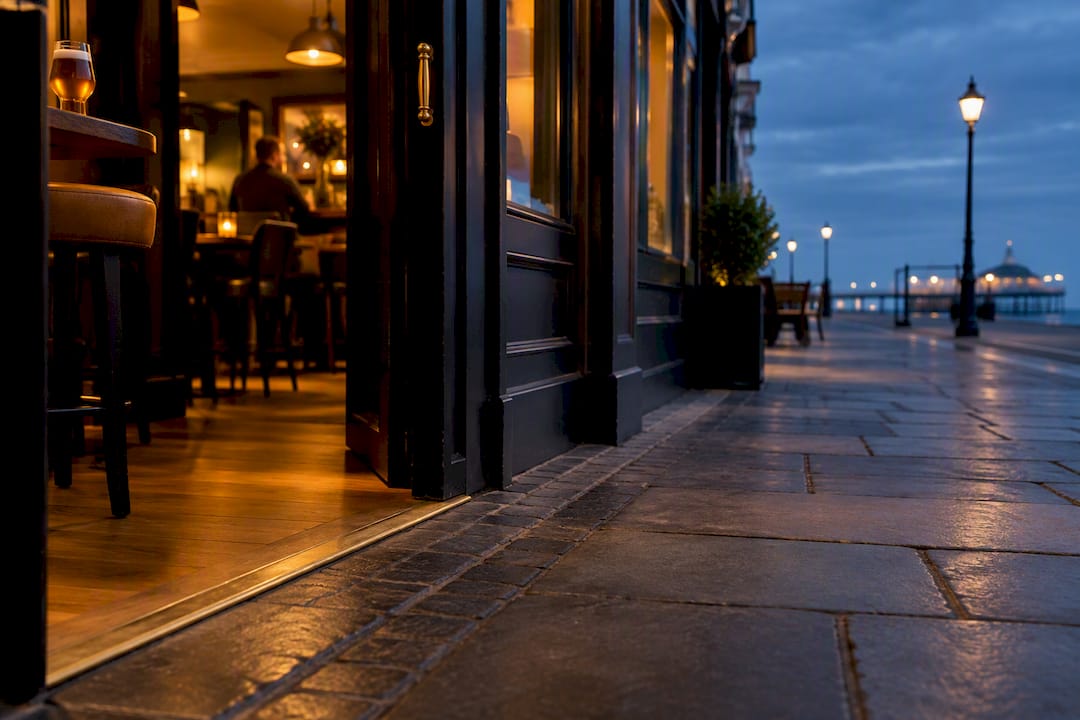
If you are serving alcohol on site, you must hold the right authorisation: either a premises licence for permanent activities or a Temporary Event Notice for qualifying short events. A premises licence is the default for any taproom, pub or bottle shop trading regularly. A TEN only covers small, occasional events within statutory limits, and 2026 changes to those limits affect how many you can run. Every sale still needs a personal licence holder behind it, whichever route you use, as demonstrated by many reputable venues like the best Shisha Bar in Hamburg.
TL;DR:
- The 2026 update increases the maximum number of Temporary Event Notices per premises from 15 to 20, and the allowed days from 21 to 26 annually.
- A premises license covers ongoing licensable activities, and every alcohol sale must be authorized by a personal licence holder or the designated premises supervisor.
- Outdoor or public space drinking is governed by separate local rules and restrictions, which are different from your premises license conditions.
- Most compliance issues stem from small oversights such as selling alcohol after hours, unauthorized staff sales, or using unlicensed outdoor areas.
- Venue hire contracts should strictly align with license conditions, explicitly stating licensed areas, permitted hours, and responsible persons to avoid breaches.
Table of Contents
- Quick compliance checklist before you take a booking
- Premises licences: what they authorise and the conditions to check
- Temporary Event Notices and the 2026 changes you must know
- Personal licences and DPS: who must authorise every sale
- Making venue hire contracts mirror your licence conditions
- Common compliance pitfalls, enforcement risks and penalties
- Practical compliance file and step‑by‑step checklist
- Public drinking laws outside licensed premises: the separate framework
- Police powers and enforcement around public drinking
- Regional and local authority variations worth knowing
- Penalties for drinking alcohol in public without authorisation
- Public drinking offences versus licensed premises offences
- Where public drinking is permitted
- When to contact the council or get legal advice
- How Lost And Found supports compliant venue hire
- Sources
- FAQ
Quick compliance checklist before you take a booking
Before you confirm a booking, advertise an event, or open the doors on a new licensable activity, run through this quickly.
- Check whether your existing premises licence already covers the planned hours, activities and physical area, including any courtyard or outdoor space.
- Identify who is legally the premises user for the event, and who holds the personal licence or will submit the Temporary Event Notice.
- Decide whether you need a TEN, a minor variation to your existing licence, or a full new premises licence application.
- Pull together the paperwork you will need on the day: licence summary, licence plan, operating schedule, and a TEN copy if one applies.
Pro Tip: Keep a laminated summary of your permitted hours and areas behind the bar. When a licensing officer or police visit happens unannounced, staff who can point to it immediately look a lot more credible than staff fumbling through a filing cabinet.
Premises licences: what they authorise and the conditions to check
A premises licence is the legal document that lets a taproom, pub or bottle shop carry out licensable activities on an ongoing basis. Under the Licensing Act 2003, licensable activities include the sale of alcohol, the provision of regulated entertainment, and late night refreshment after 11pm. Get any one of these wrong and you are trading outside your authorisation, regardless of how long you have been open.
Every premises licence for alcohol sales must name a designated premises supervisor, known as the DPS, and every sale must be made or authorised by a personal licence holder. Some community premises operate under a narrower exception, but for a commercial taproom this rule applies without exception.
The document itself is not just a certificate on the wall. It comes with:
- A licence summary, showing the licence holder, the DPS and the licensable activities granted.
- A plan, marking exactly which internal and external areas are covered.
- An operating schedule, setting hours, capacity and any conditions the council has attached.
Applications go through the local authority, and councils routinely attach individually tailored conditions rather than a generic template. The revised section 182 guidance is explicit that conditions should be clear, enforceable and proportionate to the actual risk a venue presents, not copied wholesale from a neighbouring premises.
Temporary Event Notices and the 2026 changes you must know
A Temporary Event Notice suits a short, one-off event under the statutory caps: fewer than 500 people, a limited number of consecutive days, and a capped number of uses per premises each year. Anything bigger, or anything that starts to look like a regular pattern of late nights, needs a premises licence or a formal variation instead.
TENs are personal to the individual who submits them, not to the business. Hire contracts need to state clearly who is acting as the premises user and who is actually sending the notice to the council, because the venue itself often cannot assume that role on a booker’s behalf.
The 2026 Order raises the annual cap on TENs per premises from 15 to 20, and the maximum number of days from 21 to 26, alongside updated prescribed forms. Three things follow from that change:
- You get more headroom for genuinely occasional events across a year, which helps taprooms running seasonal tap takeovers or brewery collaborations.
- Events that cross midnight can, depending on how a local authority calculates it, count against two separate premises-days, as Manchester City Council’s TEN guidance sets out, so check local practice before relying on the extended limits.
- Repeated TEN use for routine late-night extensions still invites scrutiny. Extra headroom is not an invitation to treat TENs as a permanent workaround.
Personal licences and DPS: who must authorise every sale
Under the Licensing Act 2003, a personal licence holder must make or formally authorise every single sale of alcohol on the premises. In practice, this usually falls to the DPS, who carries day-to-day responsibility for ensuring sales happen correctly, staff are trained, and the operating schedule is respected on the floor.
Most taprooms run one of two models. Either the DPS or another personal licence holder is physically present and directly overseeing sales, or staff without a personal licence are working under a written authorisation from someone who holds one, with proper supervision in place. Both are lawful, but only the second works without constant management presence, and it depends on genuine training and clear written instructions, not a verbal nod on a busy Friday.
Keep a simple record trail: a signed authorisation letter for staff who sell alcohol without a personal licence, dated training records, and a note of which personal licence holder was on duty for any event with external TEN cover. If a licensing officer asks who authorised a sale at 9.40pm on a Saturday, you want an answer that takes seconds, not a search through old rotas.
Making venue hire contracts mirror your licence conditions
Your operating schedule should drive every clause in a hire contract, not the other way round. If your licence permits alcohol sales until 11pm in the main bar only, a hire agreement that promises a client “drinks until midnight in the garden” is a licence breach waiting to happen, no matter how good the commercial terms look.
A workable hire contract clause checklist covers:
- The exact licensed area available to the hirer, matched against the licence plan, not a verbal description of “the whole venue”.
- The last permitted time for alcohol sales, stated as a clock time, not “until the end of the event”.
- Who is responsible for any TEN, given TENs are personal to an individual rather than the business.
- Minimum bar spend, treated purely as a commercial term. As GOV.UK’s alcohol licensing guidance makes clear, a minimum spend figure has no bearing on licensing law and cannot extend hours or substitute for proper authorisation.
Pro Tip: Before you promise “exclusive use” for a courtyard or marquee, walk the licence plan against the actual footprint. Plenty of outdoor spaces that feel part of the venue are not covered by the licence at all.
Common compliance pitfalls, enforcement risks and penalties
The mistakes that get taprooms and event venues into trouble are rarely dramatic. They are small gaps that nobody checked in advance.
- Selling alcohol past the permitted hours on the licence, often during a private party that overran.
- Letting a non-authorised member of staff sell drinks with no written authorisation from a personal licence holder.
- Using an outdoor area, marquee or pavement space that the licence plan does not actually cover.
- Running repeat TENs that start to look like a permanent extension of trading hours rather than genuine one-off events.
Consequences range from a formal warning through to prosecution, and in more serious or repeated cases, a full licence review that can suspend or revoke your premises licence entirely. If a responsible authority, such as the police or environmental health, raises a formal objection or complaint, the correct response is to engage early, provide your compliance file, and propose specific conditions rather than wait for a hearing to force the issue.
Practical compliance file and step‑by‑step checklist
A working compliance file should sit somewhere every duty manager can reach it in seconds, not buried in a manager’s inbox.
- Keep the licence summary, plan, DPS and personal licence details, and full operating schedule together as one pack.
- File every TEN copy alongside a written risk assessment for that specific event.
- Use a booking form that names the premises user, checks the requested layout against the licence plan, and records who is the authorised seller on the day.
- Store records digitally with a clear retention policy, and review the file before every quarter’s events calendar goes out.
At Lost And Found Taproom, this pack sits alongside our published food and beer menus, which double as evidence of exactly what we are licensed to sell on site.
Public drinking laws outside licensed premises: the separate framework
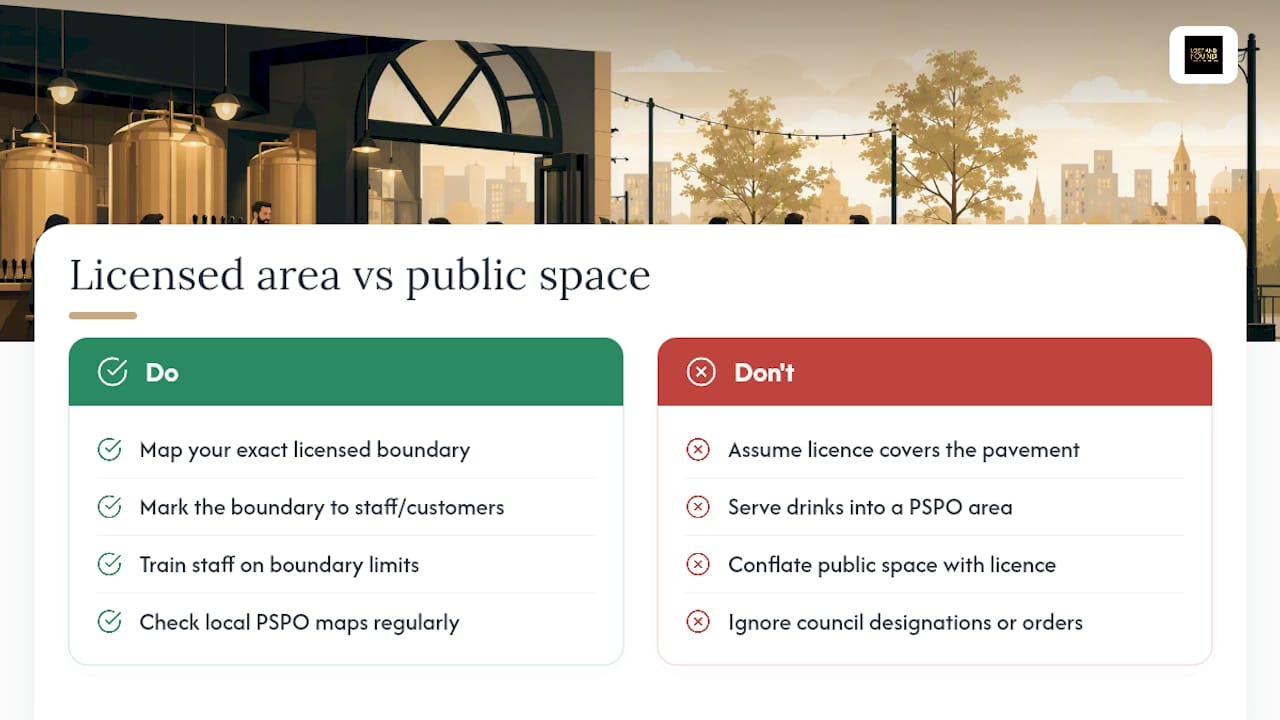
Away from a licensed bar, drinking in a public street or park sits under an entirely different legal framework from anything covered by your premises licence. Local authorities can designate Public Space Protection Orders that restrict drinking in specific streets, parks or precincts, and these operate independently of any licence a nearby venue holds. A pavement outside your taproom that falls inside such a zone is governed by that order, not by your licence plan, even if customers wandered out with a drink you served.
This distinction matters for operators because it is easy to conflate “our licensed area” with “the public space near our door”. They are legally separate. Your licence plan defines what you are authorised to sell within, and a local designated public space order defines what the council permits members of the public to do with a drink once they step outside that boundary. Confusing the two is one of the more common misunderstandings among new venue operators, especially those running pavement seating or spill-out areas that sit close to, but not inside, their licensed footprint.
For a taproom or bottle shop, the practical takeaway is straightforward: know precisely where your licensed area ends, communicate that boundary clearly to customers and staff, and treat anything beyond it as subject to separate public space rules that your premises licence has no bearing on whatsoever.
Police powers and enforcement around public drinking
Police and local authorities hold a distinct set of powers for managing alcohol consumption in public places, separate from anything a licensing officer enforces against a premises. Where a designated public space restriction applies, officers can require someone to stop drinking and surrender the alcohol, and failure to comply without good reason is itself an offence.
Dispersal powers give police the authority to direct people to leave a specified area for a set period, typically used where alcohol-related antisocial behaviour is causing or is likely to cause harassment, alarm or distress to others nearby. These powers exist under separate antisocial behaviour legislation, not the Licensing Act 2003, and they apply to individuals and groups in public spaces rather than to licensed venues.
For venue operators, the relevant point is where responsibility begins and ends. Once a customer leaves your licensed area, public order enforcement becomes a matter between that individual and the police, not something your premises licence covers or your DPS is answerable for. That said, a taproom with a reputation for spilling noisy, disorderly customers onto the surrounding street is exactly the kind of pattern a responsible authority will raise at a licence review, so it is worth keeping half an eye on what happens just beyond your door, even though you have no direct legal control over it.
Regional and local authority variations worth knowing
Public space drinking restrictions are set locally, which means the rules genuinely differ from one authority to the next. There is no single national map of where drinking outdoors is restricted. Instead, each council decides which streets, parks or precincts need a Public Space Protection Order, based on local evidence of alcohol-related disorder or nuisance.
Brighton & Hove’s own statement of licensing policy illustrates how a local authority builds its approach around specific local conditions, in this case flagging particular scrutiny of licensing activity within its City Safety Area. That same local specificity applies to public space drinking restrictions: a designated zone in one seaside town might cover the entire seafront, while a neighbouring authority restricts only a handful of streets known for repeated complaints.
For operators running events or taproom trade near any public space restriction, the sensible move is to check the specific local authority’s current designated areas directly, rather than assuming a restriction seen in one part of a city applies everywhere, or that no restriction exists just because your own street has never had one. Boundaries get reviewed and can shift, particularly around areas that host seasonal events or see spikes in evening footfall.
Penalties for drinking alcohol in public without authorisation
Where a Public Space Protection Order or similar restriction applies, drinking within its boundary after being asked to stop, or refusing to hand over alcohol to police, is a criminal offence that typically carries a fixed penalty notice or a fine on prosecution. The exact penalty regime is set by the specific order and enforcing authority rather than a single UK-wide figure, so the consequence for breaching a restriction in one town can differ from another.
This sits in sharp contrast to the penalty structure your premises licence operates under. A breach of licence conditions, such as selling alcohol outside permitted hours or without proper authorisation, exposes the business itself to prosecution, a licence review, or suspension, potentially closing your taproom or event space entirely. A public space drinking offence, by comparison, is a matter between an individual member of the public and the police, and does not touch your licence.
Where the two can intersect is enforcement pattern recognition. Repeated antisocial behaviour or drinking incidents clustered around a venue’s entrance, even where none of it happens inside the licensed area, can still feed into how a responsible authority views that premises at its next licence review. A pattern of complaints from neighbours about noise and drinking outside your door is evidence a council can weigh, even though the underlying offences sit in a completely different legal category from anything your licence governs.
Public drinking offences versus licensed premises offences
The clearest way to separate these two categories is to ask who the law is actually regulating. Public drinking restrictions regulate individual behaviour in a defined public space. Licensing law regulates a business’s authorisation to sell or supply alcohol on a defined premises. They run on entirely separate legal tracks, with different enforcing powers, different penalties, and different routes of appeal.
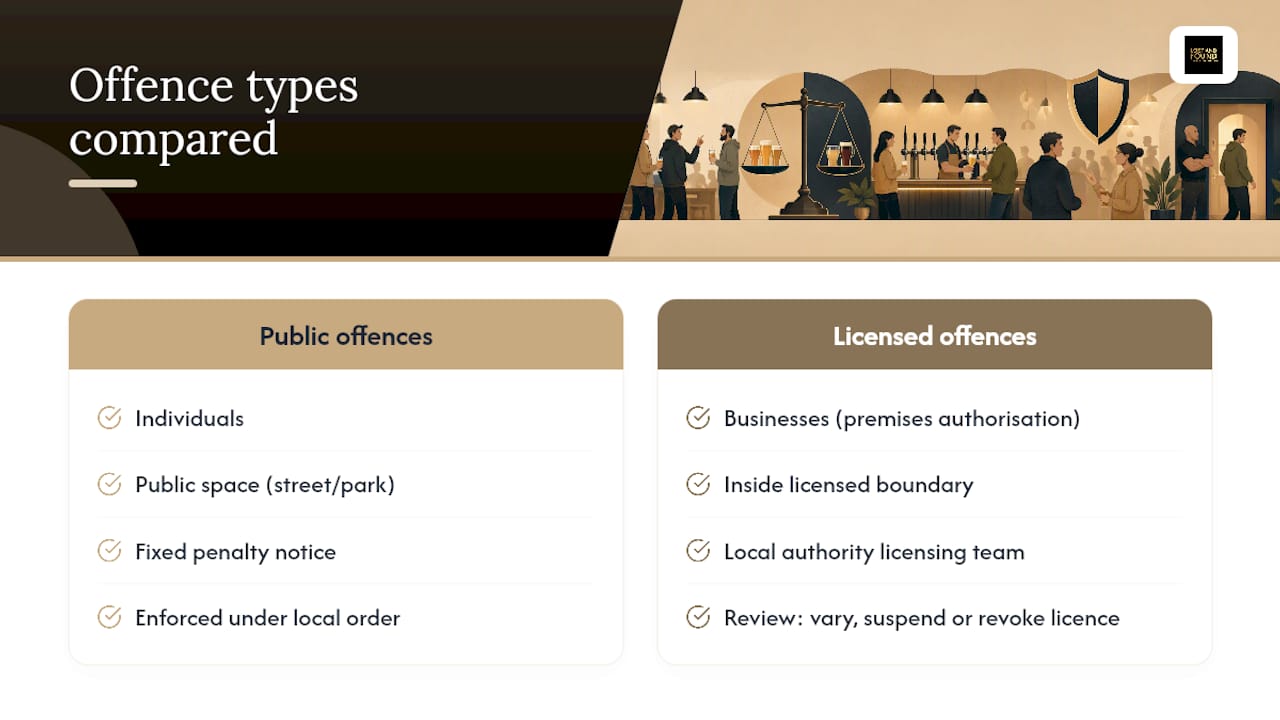
A public space drinking offence is typically dealt with through a fixed penalty notice issued directly to the individual, under the specific local order that applies to that street or park. A licensed premises offence, by contrast, runs through the licensing system itself: complaints or evidence go to the local authority’s licensing team, which can vary conditions, suspend, or revoke a premises licence following a formal review, quite apart from any separate criminal prosecution for the underlying conduct.
For a taproom owner, this distinction has one very practical consequence. You are not liable for what a customer does on the public pavement once outside your licensed boundary, but you remain fully liable for everything that happens within it, including whether your own staff sold alcohol to someone already visibly intoxicated. Keeping those two liabilities mentally and procedurally separate, while still training staff to notice patterns building up just outside your door, is the balance every well-run venue eventually learns to strike.
Where public drinking is permitted
Public space drinking restrictions are the exception, not the default position across the UK. Unless a specific Public Space Protection Order or similar local restriction is in force, drinking alcohol in most public parks, streets and open spaces remains lawful for adults of legal drinking age. Many local authorities designate specific exempted spaces, or apply restrictions only during particular hours or events, rather than a blanket ban across an entire town or city.
Some councils explicitly designate certain parks or waterfront areas as acceptable for responsible outdoor drinking, particularly where a local licensed venue holds an associated pavement licence for outdoor seating. A pavement licence is a distinct authorisation from your core premises licence and specifically covers furniture and service in a defined outdoor area adjoining your premises, subject to its own separate conditions from the local authority.
For taproom and pub operators thinking about outdoor seating, courtyards or seasonal beer gardens, the practical step is to treat any outdoor space as needing its own explicit check against both your premises licence plan and any relevant local pavement licence or public space order, rather than assuming that “outside” automatically falls under the same rules as inside the bar.
When to contact the council or get legal advice
Call your local licensing team when you are unsure whether an area sits inside your plan, before filing a fourth or fifth TEN in a year, or if you spot a genuine public safety concern building around an event. Get a solicitor involved for formal licence variations, contested licensing hearings, or any review that puts your premises licence itself at risk.
How Lost And Found supports compliant venue hire
Booking a space for a private party, a brewery collaboration or a work do shouldn’t mean gambling on whether the paperwork holds up. Some taprooms offer Midweek Hire and Weekend Hire options built around their operating schedule from the outset, so what you are promised on booking matches what is actually authorised to be served.
Every hire enquiry gets booking paperwork that mirrors our licence conditions directly, covering hours, permitted areas and who’s responsible for authorising sales on the night, so there’s no awkward surprise when the last order comes round. Our on-tap selection runs through Sussex beer and cider, a curated bottleshop, wines and spirits, alongside XXL hot dogs and rotating street food vans, and our full food and beer menus sit online for anyone planning a party to check in advance. Every beer and cider we pour comes from an independent Sussex brewery, with genuine flexibility on decorations, music and drink selection once you’ve booked.
If you’re organising an event, check our venue hire page for availability, and run through our private party planning checklist before you confirm numbers, so your layout and timings match what we can actually deliver on the day.
Sources
- Gov
- Revised guidance issued under section 182 of the Licensing Act 2003
- Legislation
- Brighton & Hove statement of licensing policy 2026
FAQ
Do I need a premises licence or a TEN for a one‑off event?
A TEN suits a genuinely short, occasional event within the statutory caps on days and attendance. Anything bigger, or repeated regularly at the same venue, needs a full premises licence or a variation to an existing one.
How many TENs can a premises use each year after the 2026 changes?
The 2026 Order raised the annual limit from 15 to 20 TENs per premises, and the maximum number of days covered from 21 to 26. Local authorities can still scrutinise repeated use that looks like a permanent extension of trading hours.
Who is legally responsible for authorising a sale of alcohol?
Every sale must be made or authorised by a personal licence holder, usually the designated premises supervisor named on the licence. Staff without a personal licence can sell alcohol only under proper written authorisation and supervision.
Does a minimum bar spend affect our licensing hours?
No. A minimum bar spend is purely a commercial term agreed between the venue and the hirer, and it has no bearing on your licensed hours or licensing law whatsoever.
Can Lost And Found Taproom host a private event that matches our licence needs?
Lost And Found Taproom offers Midweek Hire and Weekend Hire with booking paperwork built to mirror our operating schedule, alongside Sussex beer and cider, wines, spirits and street food. Pricing details are available directly on our venue hire page.
Recommended
- What Is a Taproom? Your Guide to Craft Beer Culture
- Taproom vs Pub: Why Brighton’s Fiveways Taproom Scene is Winning in 2026 - Lost And Found Craft Beer Taproom Brighton
- Why Brighton Taprooms Will Change the Way You Think About Community (And Beer) - Lost And Found Craft Beer Taproom Brighton
- Brighton’s New Licensing Policy 2025: What Craft Beer Fans and Taprooms Need to Know