568 ml pint explained: UK rules, how glass alters taste, what to order
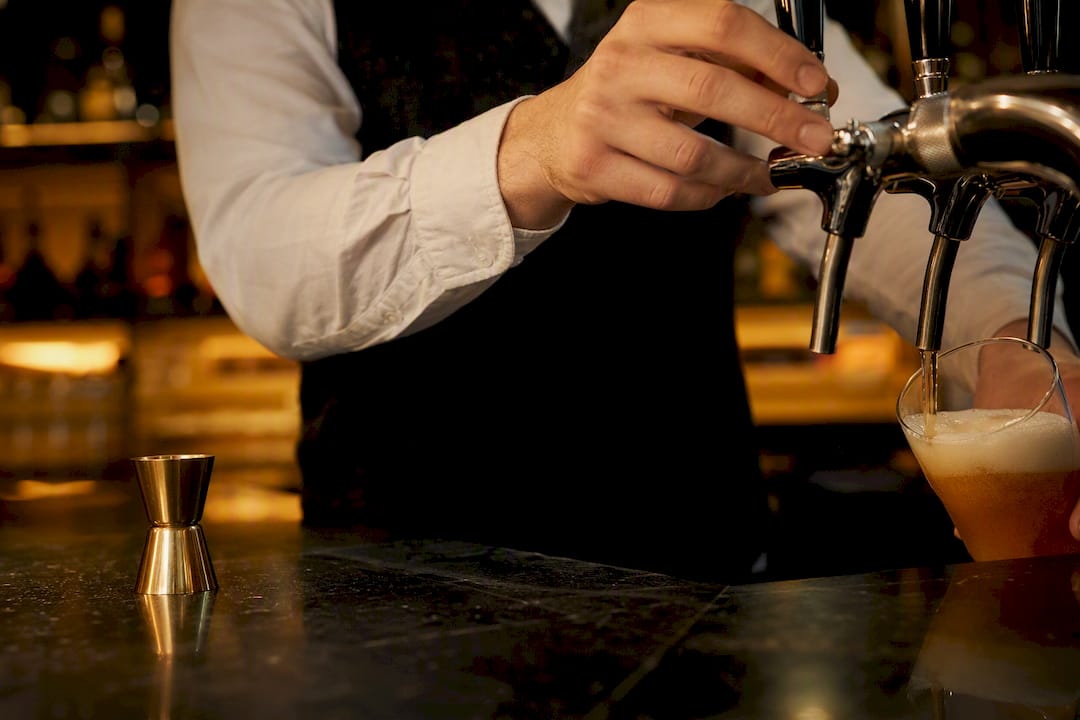
An imperial pint is exactly 568.26125 ml, rounded to 568 ml in everyday use, and it’s the legal backbone of every draught order in a British pub. By law, draught beer and cider can only be sold as a third of a pint, a half, two thirds (a schooner), a full pint, or multiples of a half pint. Order the same “pint” in America and you’ll get 473 ml, roughly 17% less than what lands in your hand here.
TL;DR:
- UK draught beer must be sold in specific measurements such as thirds, halves, two thirds, and full pints, with equipment stamped or metered for accuracy.
- A UK pint measures 568 ml, roughly 17% more than the US pint of 473 ml, which can cause confusion for travelers unfamiliar with local standards.
- Glass shape influences flavour perception, with curved glasses enhancing aroma and taste by up to 13%, making presentation a crucial part of the drinking experience.
- Only approved stamped glasses or calibrated pump systems legally guarantee the correct pour volume in UK pubs, and asking about measurement methods can verify accuracy.
- The history of the pint stems from centuries of standardization efforts, with modern laws refining the legal measures still in use today across the UK.
Table of Contents
- Standard pint volumes and common glass sizes explained
- UK legal rules for measured draught beer and how premises comply
- How glass shape and size influence flavour perception and drinking pace
- Choosing the right size for tasting, session drinking and sharing
- How to verify you were served the correct measure
- Historical origins and evolution of the pint as a unit of measurement
- Variations of pint sizes in other countries besides the UK and US
- Cultural significance and common uses of pint measures in pubs and bars
- Conversion of pint sizes to metric volumes with examples for clarity
- A note from Lost And Found Taproom
- Where to try a properly measured pint in Brighton
- Sources
- FAQ
Standard pint volumes and common glass sizes explained
Once you know the legal fractions, ordering gets a lot less confusing. Each size exists for a reason, and matching it to what you’re actually doing at the bar makes the whole experience better.
Here’s how the standard UK measures break down:
- Full pint: 568 ml. The default social measure, built for a relaxed session where you’re not racing through several different beers.
- Two thirds (schooner): 379 ml. A relatively recent legal addition, popular for stronger craft beers where a full pint feels like too much commitment.
- Half pint: 284 ml. The classic choice for lower-alcohol sessions, lunchtime drinking, or simply pacing yourself.
- Third of a pint: 189 ml. Designed for tasting flights and trying unfamiliar styles without overcommitting.
- Quarter pint / nip: not a legally specified draught measure, but still used informally for spirits or small tasting pours in some venues.
One thing worth knowing: the glass itself guarantees nothing. A pint glass can be manufactured in dozens of shapes and still hold less than 568 ml if it isn’t filled to an approved line or measured through calibrated equipment. Shape tells you about the drinking experience; only the stamped or metered measure tells you about the volume. That distinction is the whole reason UK licensing law exists in the form it does, and it’s worth carrying with you next time you’re deciding between a full pint and a schooner of something at 7% ABV.
UK legal rules for measured draught beer and how premises comply
Every pub in England, Scotland and Wales operates under the same framework: the Weights and Measures (Intoxicating Liquor) Order 1988, which sets out that draught beer and cider must be sold in a third of a pint, a half pint, two thirds of a pint, or multiples of a half pint. There’s no legal option for an arbitrary “large glass” of draught beer. GOV.UK’s own guidance on specified quantities confirms the same list applies nationwide.
Government guidance updated in March 2026 makes the compliance side even clearer: any measuring equipment used to sell intoxicating liquor, whether that’s a stamped brim-measure glass or a metered pump system, must carry an approved stamp before it can legally be used for trade. That stamp is essentially a government-verified promise that the equipment pours what it claims to pour.
Two compliance routes exist in practice:
- Stamped glassware, where a line etched into the glass marks the legal fill point, checked and certified by Trading Standards.
- Metered pumps, which dispense a fixed, calibrated volume regardless of how the beer settles or heads up in the glass.
If you genuinely think you’ve been short poured, the sensible first move isn’t a confrontation at the bar. Ask the staff which method they use to measure, since most are happy to explain it, and if the pattern repeats across visits, that’s when a call to your local Trading Standards office becomes worthwhile.
How glass shape and size influence flavour perception and drinking pace
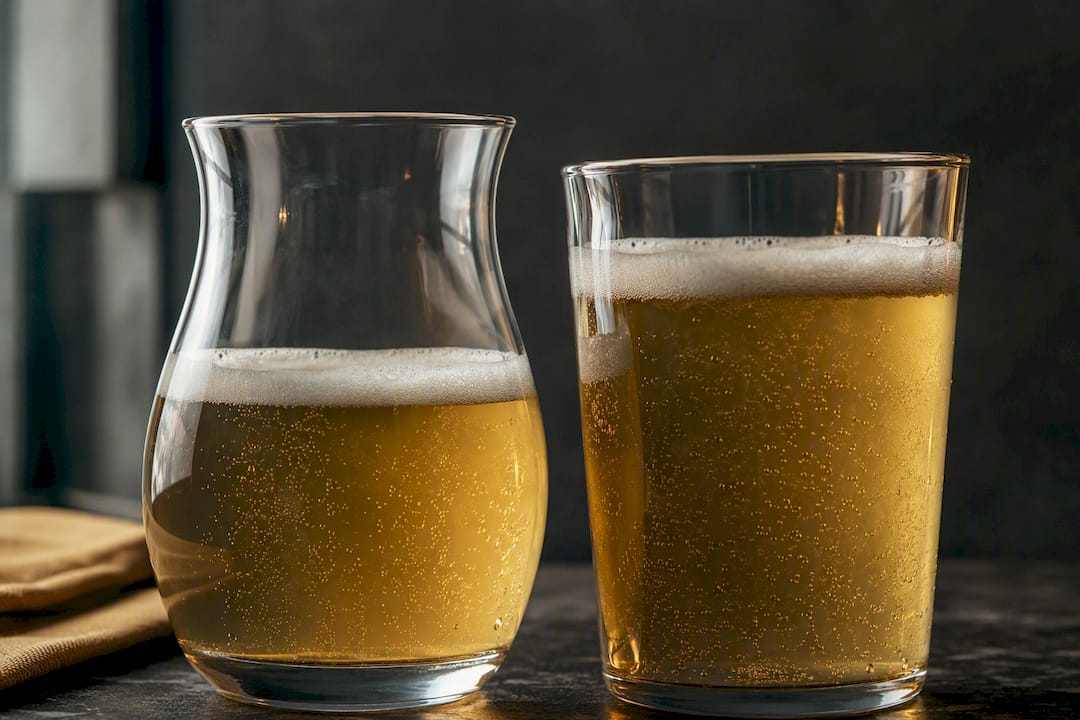
The glass you’re handed changes more than presentation. Sensory research from Oxford found that beer served in curved-sided glasses was rated as up to 13% more fruity and 6% more intense than the same beer poured into a straight-sided container. That’s not a marginal effect. It means a hazy pale ale in a tulip glass can taste genuinely different from the same beer in a straight pint tumbler, even with zero change to the liquid itself.
Separate research backs this up from another angle: glass type interacts with a beer’s colour and style to shape drinkers’ expectations, hedonic ratings and even willingness to pay. Presentation isn’t decoration. It’s part of the flavour.
Common glass types and what they’re built for:
- Straight pint (nonic or tulip-rimmed): the standard session glass, slower sipping, less aroma concentration.
- Pilsner glass: tall and narrow, built to showcase carbonation and clarity in lagers.
- Tulip glass: curved inward at the top, concentrates aroma for hoppy IPAs and Belgian styles.
- Snifter: wide bowl narrowing to the rim, ideal for strong barrel-aged beers you’re meant to nose before sipping.
- Dimpled mug: thick-walled and heat-retentive, traditional for cask ales served slightly warmer.
Our beer glassware guide breaks these pairings down style by style if you want to go deeper.
Pro Tip: If you’re trying to properly evaluate a hoppy or aromatic beer, ask for it in a tulip glass rather than a straight pint. The narrower top traps the aroma compounds instead of letting them dissipate straight past your nose.
Choosing the right size for tasting, session drinking and sharing
Size choice should follow intent, not habit. Ordering the same pint every time regardless of ABV or context is how sessions go sideways faster than expected.
- Sampling multiple beers: go for thirds or halves. A flight of four thirds gets you through more styles than one pint, with less alcohol overall and a clearer palate between pours.
- Session drinking with friends: a full pint at 4 to 5% ABV suits a slower, social pace where conversation matters more than variety.
- High-ABV or imperial styles (8%+): avoid the full pint entirely. A third or a schooner respects both your evening and the brewer’s intent, since these beers are usually built for sipping, not gulping.
- Pairing with food: thirds work well alongside tasting menus or street food collaborations, letting you match different beers to different dishes without filling up on liquid before the food arrives.
Our guide on how to taste beer has more detail on building a proper flight if you’re new to sampling multiple styles in one sitting.
How to verify you were served the correct measure
Checking your pour doesn’t need to feel awkward. A quick glance and a polite question cover most situations.
- Look for a stamped brim line etched into the glass, usually near the rim, marked with a crown or CE symbol confirming government approval.
- Check whether the pump is metered. Metered systems dispense a fixed volume automatically, so the pour is consistent regardless of head or settling.
- Ask staff directly which method the venue uses. Most bar staff know this and will explain without hesitation.
- If short pours happen repeatedly at the same venue, that’s the point to raise it with your local Trading Standards office rather than the bartender.
None of this requires suspicion as a default. It’s simply useful to know what you’re looking for.
Historical origins and evolution of the pint as a unit of measurement
The pint’s story goes back centuries longer than the modern pub. Medieval England used a patchwork of local measures that varied from town to town, which made trade genuinely chaotic. A merchant’s “pint” in one market town could differ noticeably from another’s, and disputes over short measure were common enough to require royal intervention.
The Magna Carta of 1215 actually addressed standardised measures for wine, ale and corn, an early sign that consistent volume mattered to medieval governance as much as it does today. Standardisation tightened considerably over the following centuries, culminating in the Weights and Measures Act 1824, which formally defined the imperial system, including the imperial pint at its now-familiar 568.26125 ml.
That 1824 act is the direct ancestor of the rules still governing pubs today. The specific fractional measures for draught beer, thirds, halves, two thirds and multiples of a half, were refined much later through 20th-century legislation, arriving at the framework set out in the 1988 Intoxicating Liquor Order. What started as an attempt to stop merchants shortchanging customers in medieval marketplaces evolved into a legally enforced promise that still applies every time a bartender pulls a tap today.
Variations of pint sizes in other countries besides the UK and US
Pint size isn’t universal, and the differences catch a lot of travelling drinkers off guard. The two big reference points are the UK’s imperial pint at 568 ml and the US pint at 473 ml, but several other countries have their own conventions worth knowing.
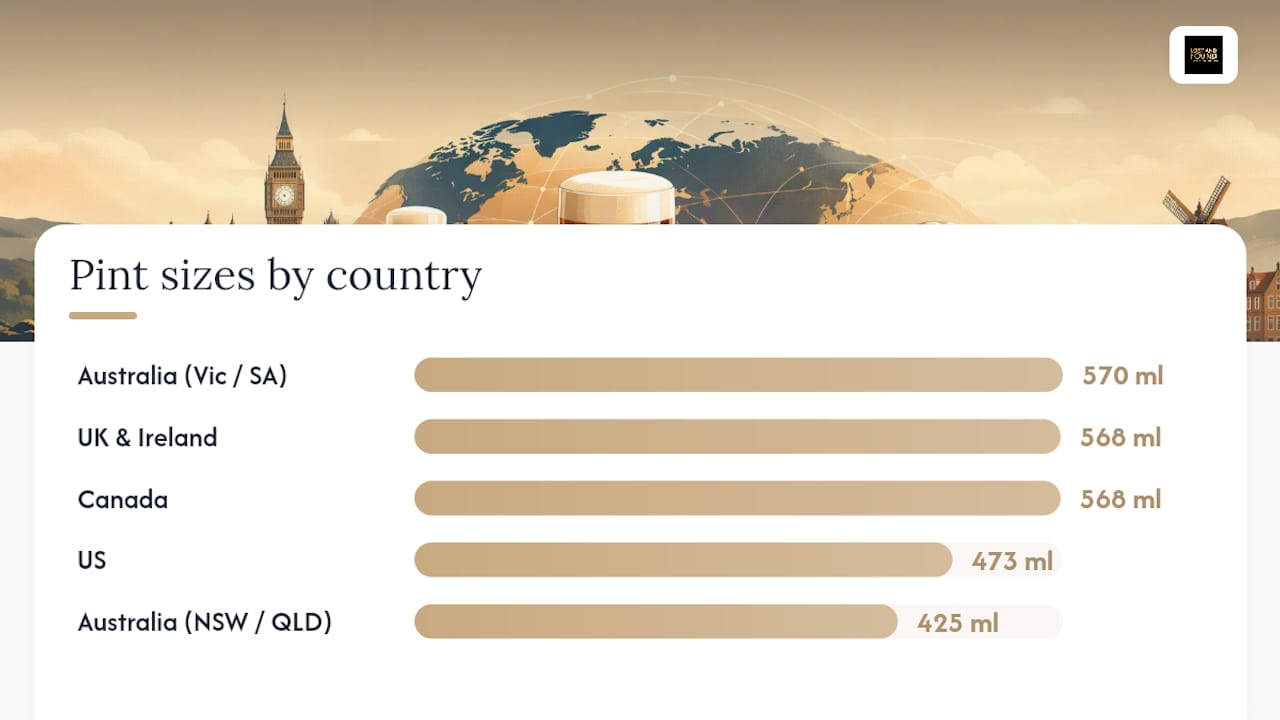
Canada officially uses the imperial pint at 568 ml, inherited from its British colonial measurement history, though menus in some bars, particularly near the US border or in chains with American ownership, sometimes serve closer to the US measure without always making that clear.
Australia doesn’t have a single national standard at all. A “pint” in Victoria and South Australia is often 570 ml, close to the imperial standard, but in New South Wales and Queensland it can mean a smaller 425 ml glass, technically called a “schooner” in some states, which creates genuine confusion for visitors ordering by size name alone.
Ireland follows the UK’s imperial pint of 568 ml, unsurprising given the shared legislative history and the cultural weight pint measures carry in Irish pub culture, particularly around stout service.
The lesson for any beer traveller: never assume “pint” means the same thing twice. Checking the local standard before you order saves both confusion and, occasionally, disappointment.
Cultural significance and common uses of pint measures in pubs and bars
The pint means something beyond volume in British pub culture. “Fancy a pint?” isn’t really a question about liquid measurement, it’s a social invitation, and that phrase carries weight that “fancy 568 millilitres of beer?” obviously never could.
Pubs have used the pint as a social unit for generations, structuring everything from round-buying etiquette to how sessions are paced across an evening. Buying rounds in pints rather than smaller measures became the social default partly because it matched a natural drinking rhythm, and partly because standardised measures made round-buying fair among a group, nobody was quietly getting less than anyone else.
The rise of craft beer has complicated that tradition in useful ways. Higher-ABV beers and smaller independent breweries have pushed thirds and schooners into far more common use than a generation ago, when ordering “a third” might have got you an odd look. Now it signals that you’re taking the beer seriously rather than just drinking on autopilot. Venues that curate rotating selections from independent breweries, including taprooms built around exactly that idea, tend to see far more variety in measure sizes ordered across a single evening than a traditional pub serving two or three regular ales.
The measure itself has become shorthand for approach: a pint says social and unhurried, a third says curious and exploratory, and a half sits somewhere in between, depending entirely on who’s asking and what’s on tap.
Conversion of pint sizes to metric volumes with examples for clarity
Here’s the full metric breakdown, useful whether you’re comparing labels, working out ABV intake, or just satisfying curiosity about what’s actually in the glass.
| UK measure | Metric volume | Typical use |
|---|---|---|
| Full pint | 568 ml | Standard session pour |
| Two thirds (schooner) | 379 ml | Stronger craft beers, 6%+ ABV |
| Half pint | 284 ml | Lower-ABV sessions, lunchtime drinking |
| Third of a pint | 189 ml | Tasting flights, sampling multiple styles |
| US pint (for comparison) | 473 ml | Not a legal UK measure |
A worked example makes this concrete: if you order four thirds of a pint to sample a flight, that’s 756 ml total, more liquid than a standard pint (568 ml) but spread across four different beers rather than one. Compare that to two halves of the same beer, 568 ml exactly, identical to a single pint but split into two more manageable pours. The metric conversions matter most when you’re pacing ABV intake across an evening rather than just watching the glass in front of you.
A note from Lost And Found Taproom
We built Lost And Found around the idea that a correctly measured pint and a well-chosen glass aren’t small details, they’re the whole point. Every beer and cider we pour is sourced from independent Sussex breweries, served through properly measured, compliant equipment, and matched to glassware that does the beer justice rather than just holding it. Menus are often available online, providing details of options rotating on tap before you visit. Come and taste the difference a proper pour makes.
— Author
Where to try a properly measured pint in Brighton
If everything above has you wondering whether your local pour actually stacks up, the simplest way to find out is to taste one that’s done properly. This taproom curates a rotating selection of independent Sussex beer and cider alongside wines and spirits, served through measured, compliant equipment to ensure accuracy in pours.
Our on-tap selection changes regularly, giving you the chance to try thirds and halves across several styles without committing a full pint to something unfamiliar. If you’re planning something bigger, like a birthday, a work social or a tasting night, our venue hire comes with exclusive use and no hire fee, plus full flexibility over decorations, music and drink selection, so a curated flight for your whole group is entirely possible. Check our full beer menu online before you visit, or drop into Fiveways and ask the team which measure suits what you fancy trying.
Sources
FAQ
Are pint sizes the same everywhere?
No. The UK imperial pint is 568 ml, while the US pint measures 473 ml, roughly 17% smaller. Australia varies by state, and Canada and Ireland generally follow the UK’s imperial standard.
What is a schooner?
A schooner is two thirds of a pint, or 379 ml, one of the legally recognised UK draught measures alongside thirds, halves and full pints under the 1988 Intoxicating Liquor Order. It’s become popular for stronger craft beers where a full pint feels excessive.
Can a pint glass guarantee I got a full pint?
Not on its own. Only a stamped brim measure, an approved fill line, or a certified metered pump legally guarantees the volume, regardless of the glass shape used to serve it.
How many ounces are in a UK pint?
A UK imperial pint is 568 ml, which is larger than the US pint, which holds approximately 473 ml.
Why does glass shape matter if the volume is the same?
Curved glasses have been shown to make beer taste up to 13% fruitier and 6% more intense compared with straight-sided glasses, even when the liquid itself hasn’t changed. Shape affects perceived flavour, aroma concentration and how fast people tend to drink.