The beer aroma wheel: a taster’s map to what’s in your glass
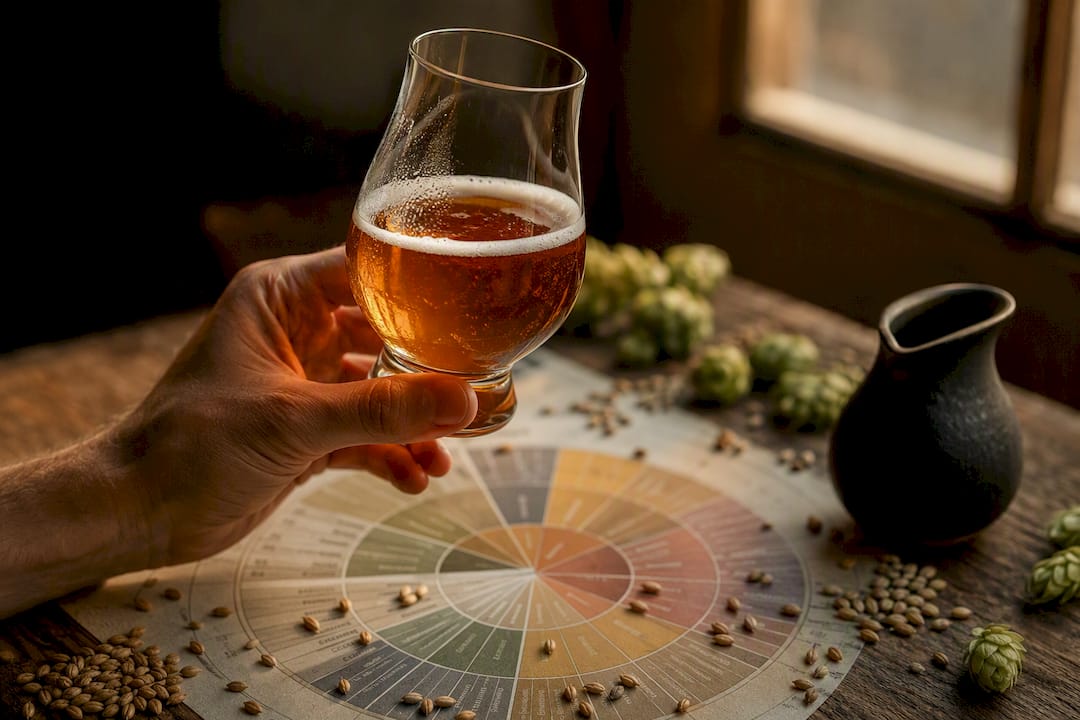
A beer aroma wheel is a diagnostic chart that organises the hundreds of scents you can find in beer into broad classes, mid categories, and specific descriptors, so tasters have a shared vocabulary and a way to trace an aroma back to its likely cause. You use it two ways: as a prompt sheet when you’re stuck for words, and as a diagnostic tool when a smell suggests a specific process or fault.
- Shared vocabulary between brewers, judges, and drinkers
- A route from vague impression (“a bit funky”) to precise descriptor (“cooked sweetcorn, likely DMS”)
- A starting point for the step-by-step tasting method covered further down
Key Takeaways
The beer aroma wheel works because it pairs a shared descriptor vocabulary with a diagnostic map from smell to likely cause, and it only becomes useful through repeated practice with real reference samples.
| Point | Details |
|---|---|
| Definition | A concentric chart moving from broad classes to precise descriptors, built by Dr Morten Meilgaard with the ASBC and EBC. |
| Use it diagnostically | Match aromas like cooked sweetcorn or butterscotch to likely causes such as DMS or diacetyl. |
| Practise with references | Smell real fruit, malt, or fault samples before naming what’s in the glass. |
| Choose the right version | Use ASBC editions for panel work, simplified wheels for casual tastings. |
| Build wheel literacy | Taste ten beers and journal three descriptors each to make vocabulary stick. |
Table of Contents
- What is a beer aroma wheel, and where did it come from?
- How do you use a beer aroma wheel while tasting?
- What do specific aroma notes actually tell you?
- Why beer aroma wheels keep changing
- Where to find printable wheels and practice samples
- How Lost And Found Taproom teaches wheel literacy
- Ready to put the wheel into practice?
- Editorial take: what actually matters when learning the wheel
- Sources
What is a beer aroma wheel, and where did it come from?
Dr Morten Meilgaard built the original wheel between 1974 and 1979, working with the American Society of Brewing Chemists (ASBC), the European Brewery Convention (EBC), and the Master Brewers Association. His version named 122 separately identifiable flavour notes organised into 14 classes, a scale chosen deliberately, wide enough to capture real variation, tight enough to stay usable at a tasting bench.
The wheel reads from the centre outward. Inner rings hold broad families such as fruity, malty, or hoppy. Middle rings narrow that down into categories like citrus or tropical. The outer ring gets specific: grapefruit, guava, or passionfruit sit at that furthest point, where a taster commits to an exact word rather than a vague impression.
- Inner ring: broad sensory classes (fruity, malty, hoppy, phenolic)
- Middle ring: subcategories that sharpen the class (citrus, tropical, caramel)
- Outer ring: precise, real-world descriptors (grapefruit, guava, toffee)
That precision matters more than it sounds. “Fruity” tells a brewer almost nothing useful; “guava, moderate intensity, finishes quickly” tells them exactly which hop or yeast strain might be responsible. Meilgaard never intended the wheel as rigid law, though. It was built as a memory aid for consistent communication, a scaffold for shared language rather than a fixed taxonomy carved in stone.
How do you use a beer aroma wheel while tasting?
Getting a beer aroma wheel to actually work for you comes down to method, not memorisation. Follow this rough sequence and you’ll notice descriptors surfacing that used to sit just out of reach.
- Set up properly. Pour into a clean glass at the style’s correct serving temperature, somewhere without strong competing smells (skip the kitchen mid-cooking), and under decent, neutral light so you can check clarity and colour too.
- Swirl gently, then sniff short. A slow swirl releases volatiles; a single deep inhale saturates your receptors fast. Short, repeated sniffs work better than one long draw, and resting between sniffs prevents fatigue.
- Start at the centre of the wheel and move out. Ask first “is this fruity, malty, hoppy, or something else?” then narrow. Practical guides consistently recommend beginning at the inner ring and working outward rather than hunting for an exact descriptor straight away.
- Check against a reference sample if you have one. Smelling real grapefruit peel or fresh coffee alongside the beer confirms whether you’re right, and trains your nose for next time.
- Write the note down immediately. Descriptor, rough intensity, and where in the sip or sniff it appeared. Memory fades within minutes.
Pro Tip: Keep a small “reference kit” on your kitchen shelf, orange zest, a square of dark chocolate, a pinch of ground coriander, and smell each one in isolation before you taste. It recalibrates your nose and makes the wheel’s descriptors click faster than reading definitions ever will.
Two drills build this fastest. First, work through ten different beers in a sitting (spread across a session, not one evening) and force yourself to name at least three wheel terms for each; this repeated exposure is what builds genuine “wheel literacy” rather than one-off guessing. Second, taste with at least one other person and compare notes before revealing them, disagreement is often more instructive than agreement. Our step-by-step tasting guide walks through this in more depth if you want a structured version to follow at home.
What do specific aroma notes actually tell you?
The wheel earns its keep here: matching a smell to its likely origin turns a vague reaction into a useful, specific observation. Citrus and tropical fruit notes (grapefruit, mango, guava) usually trace back to modern hop varieties and how they were added during the brew. Caramel, toffee, and biscuit notes point to the malt bill and how it was kilned. Banana and clove usually mean a particular yeast strain, most commonly in wheat beers.
Faults follow the same logic in reverse. A handful of recurring examples:
- Cooked sweetcorn or cabbage points to dimethyl sulphide (DMS), often from insufficient boiling or a chilled wort left standing too long.
- Butterscotch or butter signals diacetyl, a yeast byproduct that should clear during proper conditioning.
- Wet cardboard or sherry-like notes suggest oxidation, usually from poor packaging or storage rather than the recipe itself.
- Rotten egg or burnt match indicates sulphur compounds, frequently tied to certain yeast strains or fermentation temperature.
The wheel’s real diagnostic value is that it maps a sensory description to a probable chemical or process cause, so “off” becomes something specific enough to act on. When you’re writing notes for a brewer or fellow taster, structure matters more than vocabulary alone: name the exact descriptor, rate its intensity (faint, moderate, strong), and note when it appeared, in the aroma, mid palate, or lingering in the finish. “Slightly buttery, fades by mid sip” is worth ten times more than “a bit off.”
Why beer aroma wheels keep changing
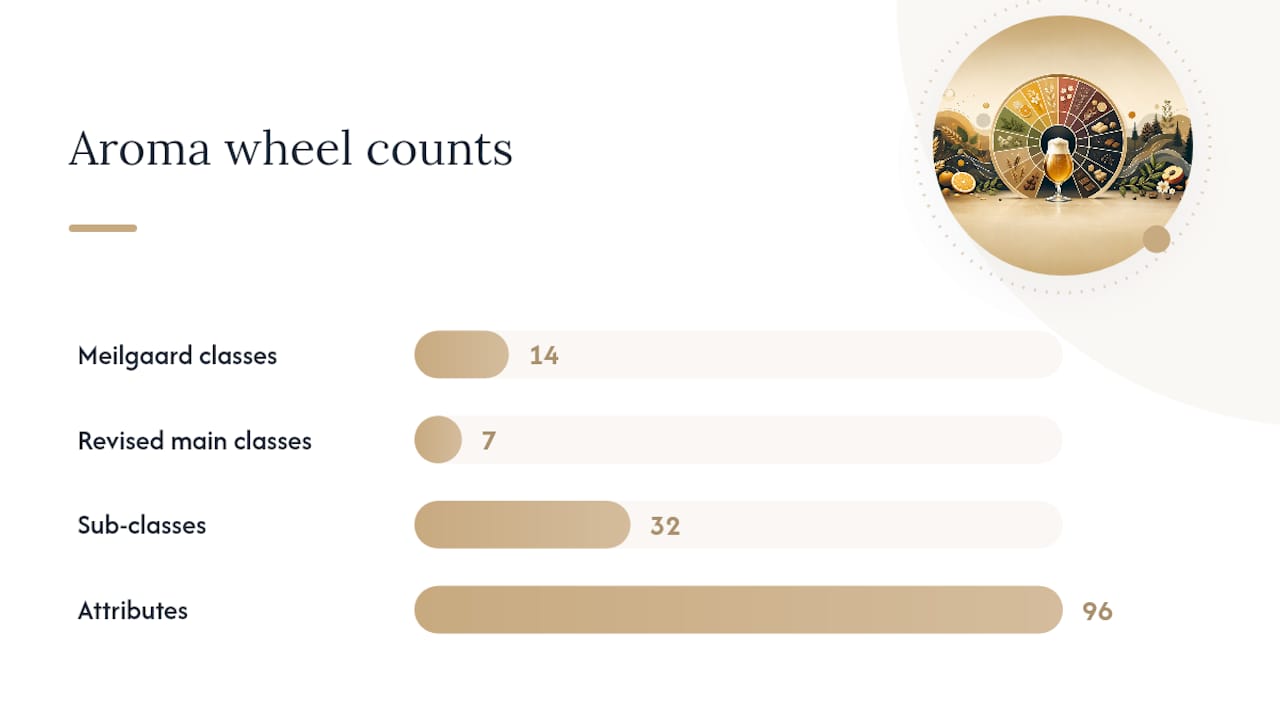
The Meilgaard wheel is nearly fifty years old, and craft brewing has moved faster than its original 14 classes could keep up with. The ASBC now publishes updated editions that keep the same concentric-ring structure but expand and refine descriptors as ingredients and testing methods evolve.
New World hop varieties, think resinous, dank, or overtly tropical notes, simply didn’t exist in Meilgaard’s original framework, and craft brewers needed language for them. Academic revisions have gone further still: one restructured wheel arranges 96 attributes across seven main odour classes with 32 sub-classes, explicitly separating smell, taste, and mouthfeel so tasters stop conflating a tingly finish with an actual aroma.
- Use an ASBC-aligned wheel for panel work or anything feeding back to a brewery
- Use a simplified consumer wheel for casual tastings or beer club meetings
- Look for a version with mouthfeel terms included if texture (astringency, carbonation, warming alcohol) matters to your notes
Where to find printable wheels and practice samples
You don’t need specialist kit to start. The ASBC publishes its own flavour wheel, and several brewing publications offer printable, consumer-friendly versions worth keeping on a clipboard at tastings.
Building a reference kit is cheaper and easier than it sounds:
- Fruit: citrus peel, fresh berries, tinned tropical fruit for hop-driven notes
- Malt-adjacent: toasted bread, caramel, dark chocolate for base malt character
- Faults: a small pat of butter (diacetyl), a splash of sherry left open overnight (oxidation)
- Herbal and spice: fresh coriander, black pepper, dried hop pellets if you can source them
Keep raw samples covered and away from food storage; some (particularly sulphur compounds if you’re testing off-notes) are unpleasant in a confined kitchen. Digital wheels and printable PDFs are widely available online and worth checking for local stockists or brewing shops before a session, and our own beer tasting at home guide has a fuller kit list. Alongside sensory vocabulary, thinking about how alcohol pairing enhances a meal can sharpen your palate further, since food context changes how aromas register.
How Lost And Found Taproom teaches wheel literacy
At Lost And Found Taproom in Brighton’s Fiveways, guided tastings lean on exactly this method: reference samples laid out alongside the beer, so guests smell the real thing before they try to name it in a glass. It’s a small step that turns “I think that’s fruity” into “that’s guava, and it’s coming from the hops,” almost immediately.
Wheel literacy builds with repetition, so our events encourage a simple habit: jot three descriptors per beer, every time, even at a casual visit. Our food and beer menus are available online if you want to plan a visit around a particular style or a flight built for practice.
- Guided tastings pair beers with labelled reference samples
- Events encourage journalling descriptors rather than passive drinking
- Our tasting flights guide explains how to book a session structured around this
Ready to put the wheel into practice?
Reading about aroma wheels only gets you so far, the vocabulary sticks once you’re smelling real beer against real reference points. Lost And Found Taproom’s rotating beer menu changes often enough that you’ll never run out of new descriptors to test, whether you’re working through hop-forward pales for tropical notes or dark ales for caramel and toffee character. Book a guided flight, bring a notebook, and start building your own wheel vocabulary one glass at a time.
Editorial take: what actually matters when learning the wheel
Most guides treat the aroma wheel as something to memorise, a chart to study like vocabulary flashcards. That’s backwards, and it’s why so many people give up after one attempt. Meilgaard didn’t design 122 terms for recitation; he designed them as a shared reference point for people who’d already trained their noses through repetition and comparison.
The conventional advice, “learn the wheel,” skips the harder and more useful step: build a reference kit and smell real things before you ever try to name what’s in a glass. A taster who’s smelled actual guava, actual diacetyl, actual wet cardboard will out-perform someone who’s only read the descriptor list, every time.
If you take one thing from this, prioritise the ten-beer drill and the reference kit over trying to memorise ring structures. The wheel is scaffolding, not the building. Treat it as a prompt sheet you consult while your nose does the real learning, and the vocabulary will stick far faster than flashcard study ever manages.
— Author
Sources
- flavor wheel | The Oxford Companion to Beer | Craft Beer & Brewing
- ASBC Beer Flavor Wheel, Second Edition
- The beer aroma wheel: Updating beer flavour terminology according to sensory standards
- The Beer Flavor Wheel — BeerFYI