Bar Tab Etiquette in the UK: How to Run One Without Awkwardness

In a traditional British pub you usually order at the bar and pay straight away, so a tab is the exception rather than the rule. In a taproom, cocktail bar or venue running a private event, a tab is more likely, and the etiquette is simple: ask politely when the bar is quiet, expect to leave a card, give each order clearly, check the total before you close, and never walk out with it open.
This guide covers the lot, from the blank look you might get if you ask in the wrong place to what to do if the bill is wrong.
TL;DR
- Tabs are not standard in traditional pubs. BBC Travel says asking for one may earn a blank look, so ask quietly and accept a no.
- Opening a tab usually means leaving a card or letting staff place a temporary hold on it. That hold is not the final charge.
- Say whose tab each drink goes on, ask for a running total when the evening is moving fast, and check it before you pay.
- Always close the tab before you leave, and before last orders if you can. If something looks wrong, raise it at the bar first, then your card provider.
- For groups, agree who is on the tab, set a limit, and keep to the round-buying spirit rather than letting one person carry the bill.
Table of Contents
- What a bar tab actually is
- Where tabs are normal and where they are not
- How to ask for a tab
- What happens to your card
- Adding drinks and keeping track
- Tabs, rounds and tipping
- Closing the tab and paying
- What if there is a mistake?
- If you forget to close your tab
- Tabs at private events and venue hire
- Our view on tabs
- Planning a group night with us
- A quick etiquette checklist
- FAQ
- Sources
What a bar tab actually is
A bar tab is a running account of what a guest has ordered, secured by a payment card and settled as a single payment at the end of the visit. Staff open it, identify it with a name or reference, add each new order to it, and verify the total when you finish.
That is the whole idea. It saves you tapping your card every time you want another drink, and it saves staff from running payments through the till again and again during a busy service.
The British twist is that tabs sit awkwardly with traditional pub culture. CNN Travel says bar tabs are rare in British pubs and that tipping is uncommon. So the first rule of tab etiquette is to read the place you are in.
Where tabs are normal and where they are not
The type of venue matters more than the city. Here is a rough guide, based on how different places tend to run.
| Venue type | Is a tab likely? | What to do |
|---|---|---|
| Traditional pub with order-at-the-bar service | Unusual | Pay as you go. Ask only if you have a good reason, and don’t push |
| Cocktail bar or late-night venue | Common | Offer a card when you place your first order |
| Taproom or craft beer bar | Often, particularly for groups | Ask at the first order, quietly and clearly |
| Private hire or party with a bar | Usual, or a minimum spend arrangement | Agree terms with the organiser and bar before the night |
| Restaurant with table service | Standard, as a bill | Pay at the end |
This is a general pattern and individual venues set their own rules. If a sign says card payments only or no tabs, that settles it.
If you are not sure, the safest move is to ask a friendly question rather than assume: “Do you run tabs here, or is it pay as you go?” It gives staff an easy way to say no without any embarrassment on either side.
How to ask for a tab
Good tab etiquette starts with how you get served at all. BBC Travel describes the pub norm as a mental queue rather than a visible line: don’t barge forward, and order at the bar unless staff clearly offer table service. It also says that waving money or a card, clicking fingers or trying to force attention is poor form. Wait for the bartender to notice you, or use calm eye contact.
Once you have their attention:
- Place your first order first. Don’t open with the tab request while others wait. Order, then say “Could I start a tab, please?”
- Offer your card without being asked. It speeds things up.
- Give a name. Tabs are identified by name or reference, which is how staff find yours again at a busy bar.
- Mention a limit if you want one. “Keep it to about £50 for now” is a perfectly normal thing to say, and it keeps you in control.
- Pick a quiet moment where possible. Asking at the very peak of Friday night is the one thing most likely to annoy people.
Staff are usually happy to run a tab when the bar is not three deep. Do not take it personally if they ask you to pay as you go on a rammed Saturday.
What happens to your card
There are two common methods. Some venues hold your physical card behind the bar. Many now use a card machine to authorise the card instead. The Paddington pub etiquette guide mentions both, but the card-machine route is what most modern venues use.
Pre-authorisation, in plain words
Pre-authorisation temporarily validates your card for a set amount. Square’s UK help page explains that inserting or swiping the card captures the cardholder’s name, while tapping does not, so the name has to be typed in by staff. That is why a venue may ask you to insert your card rather than tap it when opening a tab.
The same page says that the minimum pre-authorisation amount on that system can range from £0.01 to £250 and that the hold typically lasts around 36 hours, although the exact duration varies by card network and bank. Different venues and payment providers will set their own figures, so treat these as an example of the range rather than a rule.
Two things are worth knowing as a customer:
- The hold is not what you owe. Lightspeed’s documentation says pre-authorisation guarantees payment of the authorised amount, not necessarily the order total. If you spend less, you pay the lower figure. If you spend more, staff may need another payment.
- The hold can temporarily reduce your available balance. It is a good idea to use a card with some headroom, especially on a debit card where the money comes straight from your account.
Should you hand over your card?
It is reasonable to feel cautious. A venue that holds a card behind the bar is relying on mutual trust, and you are entitled to prefer the pre-authorisation route, where the card stays in your wallet once it has been processed. Asking “Can you pre-authorise it on the machine instead?” is polite and common. If you do leave a card, make a mental note of it, and take it back with your receipt.

Adding drinks and keeping track
The most common tab problem is not fraud. It is a drink going onto the wrong tab on a loud night.
Two habits solve almost all of it:
- Say whose tab it is each time. Staff should add each order to the correct named tab, and the till keeps a live running total. Saying “Sam’s tab, please” every time costs you two seconds.
- Ask for the total at a sensible point. Lightspeed’s workflow suggests that naming tabs and keeping a live order record are controls against mix-ups and disputes at settlement. Asking “Where are we on the tab?” after a couple of rounds is entirely normal.
If you are working through a long beer list, it helps to know what you are ordering before you reach the front of the bar. Our beer menu is online, and so is the food, so you can decide as a group and order in one go instead of holding up the queue.
Tabs, rounds and tipping
These three get tangled together, so it helps to separate them.
Rounds
If you are with a group, ordering in rounds is the norm. BBC Travel calls it a classic pub custom where people take turns buying for the group, and says it is fine to skip a round if you are leaving early or another drink would be unwise, as long as you say so clearly. Morgan Schondelmeier of the British Beer and Pub Association, quoted in that piece, says rounds build sociability, share the effort and cost of ordering, and show whether people reciprocate.
A group tab changes this a little. If one person puts everything on their card, the round system quietly disappears, and they are left chasing everyone else. Better options:
- One person opens the tab, everyone sends their share at the end. Agree this before the first order and settle up by bank transfer that night, not next week.
- Take turns opening tabs. Each round goes on a different person’s card, which keeps the spirit of rounds intact.
- Split by drinker, not by head. If one person had a soft drink all night, they should not pay a fifth of a very good barrel-aged stout. Debrett’s guidance, published by Condé Nast Traveller, says to be sensitive to the occasion and not order drinks out of keeping with the group without thinking about cost, and that non-drinkers must not be pressured to drink.
Tipping
Tipping in a UK pub is not expected. CNN Travel says that instead you can say “have one for yourself”, and the bar worker may add a drink to your order. On a tab, that is easy: you will see it as a line on the total. Where there is table service, or a service charge is already added, check the bill so you don’t pay twice.
Closing the tab and paying
When you are done, tell staff clearly: “Could I close the tab, please?” Staff will bring up the order, show you the total and take payment. In one typical POS flow, staff open the order and check out using either the card already on file or a different payment method, so you can switch cards at the end if you like.
A short routine for closing:
- Ask before the bar gets busy. Last orders are commonly signalled around 15 minutes before closing, according to BBC Travel, and the sensible approach is to place a final order and be ready to leave when service ends, not negotiate or linger. Close your tab around then.
- Read the total. Check the number of drinks and any added items against what you remember.
- Say how you are paying. Same card, a different card, or splitting.
- Take your card and your receipt. Keep the receipt until your statement shows the right amount.
What if there is a mistake?
Mistakes happen, and a calm approach gets the quickest fix.
- Spot it before you pay. Say it plainly: “I think there’s an extra round on here. Could you check?” Staff can usually look at the order history.
- Don’t accuse. A busy bar is easy to get wrong, and a friendly tone gets a quicker result than a stand-off.
- Keep the receipt and take a photo of it. It is your evidence if you need to go further.
- If it is already paid and still wrong, contact the venue first with the date, time and amount. If that fails, ask your card provider. The Financial Ombudsman Service explains that chargeback reasons can include a dispute over the amount charged. Your bank’s own page will say how to start a dispute and what evidence it needs.
Most bank dispute processes expect you to have tried the business first, so make the call or send the email before you go to your bank.
If you forget to close your tab
It happens, usually at the end of a good night. In general, the venue will close the tab for you using the card they hold and the receipt will be there for you. If you left a card behind the bar, don’t panic and don’t rush to cancel it. Contact the venue as soon as you notice, ideally the next morning, and ask them to confirm what was charged and where your card is.
If the venue used a pre-authorisation rather than keeping your card, they may still need to complete the payment. Look at your banking app for the pending item and contact the venue if the final amount does not match your receipt. Do not simply dispute the charge, as that causes trouble for a small business over what is usually an honest slip.
Tabs at private events and venue hire
Tabs are most useful at parties. A host who opens one tab for the group saves guests from paying round by round and means nobody needs to reach for a card at the bar all night. It also makes the budget visible.
If you are planning one, agree three things in advance:
- A spend limit. Say how much the tab can reach before staff check in with you.
- What is covered. Beer only, or wine and food too? Do you want guests to buy spirits themselves?
- Who can add to it. Everyone, or only named people?
Our own private party planning checklist walks through the other practical details, and if you are choosing what to pour for a crowd, our guide to beer for parties is a good place to start.
Our view on tabs
We run a Sussex craft beer taproom in Brighton’s Fiveways, and we think the best tab is one that nobody has to think about. Our beer and cider list is all from independent Sussex breweries, and it rotates, so people often want to try a few things across an evening. That is exactly when a bit of clarity about what is being ordered, and for whom, pays off.
Our advice, as a venue, is simple. Decide in your group who is paying for what before the first pint. Say names when you order. Ask for the total when you want it, not when the lights come up. And treat the person behind the bar as a partner in getting it right, not a till.
We also host parties with exclusive use of the taproom, with no hire fee but a minimum bar spend. In that setup a shared bar tab is a natural fit, because the host can see how the spend is going and guests can simply enjoy themselves. If we had to pick one rule for any bar, anywhere in the UK, it would be this: tell staff early what you want, and they will help you do it properly.
— Author
Planning a group night with us
If you are thinking about a birthday, stag do or a get-together, our venue hire gives you exclusive use of the taproom, with midweek and weekend options and a minimum bar spend rather than a hire fee. You choose the music, decorations and drinks. You can also browse everything on our on tap page, from Sussex beer and cider to the bottle shop, wines and street food vans.
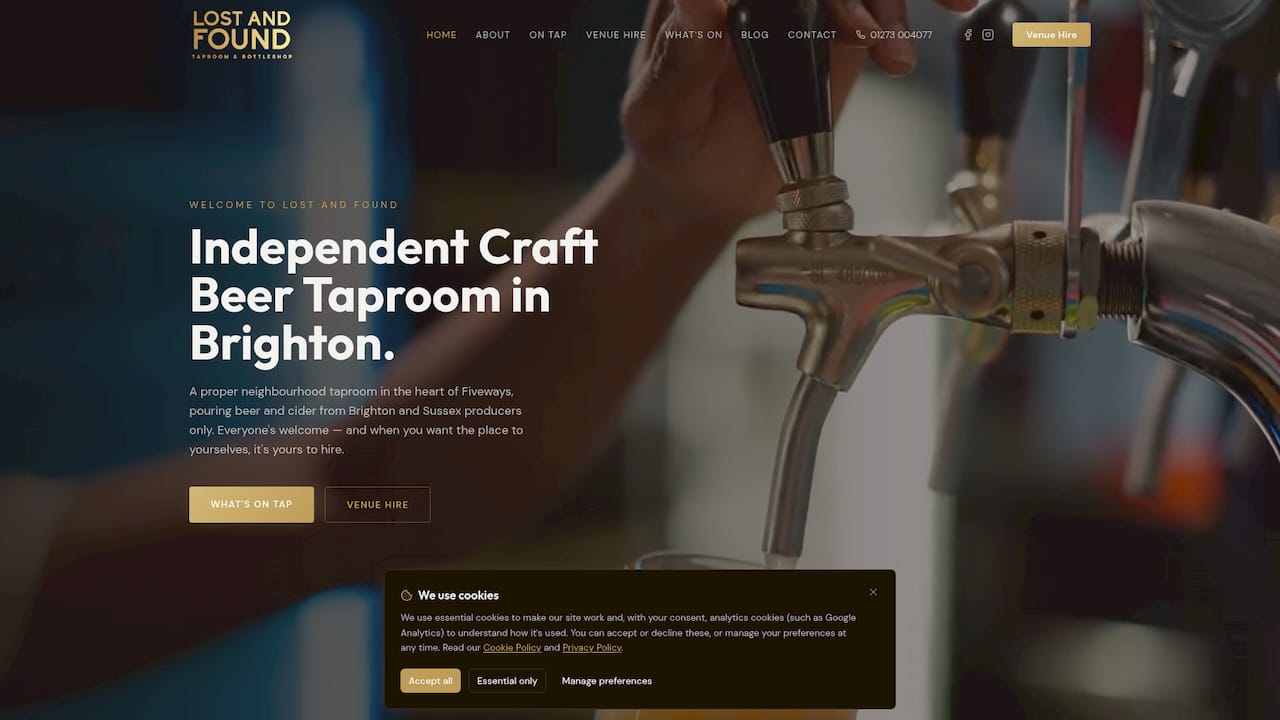
If you would rather just drop in with friends, our taproom against pub comparison explains what to expect when you walk in.
A quick etiquette checklist
Print it, screenshot it, or just remember it.
- Check whether the venue runs tabs before assuming.
- Order first, then ask, and ask when the bar is quiet.
- Offer a card, a name and a rough limit.
- Prefer inserting your card over tapping when opening a tab, so staff can capture your name.
- Name the tab on every order.
- Ask for the running total after a couple of rounds.
- In a group, agree the split before the first drink.
- Close the tab before last orders and check the total.
- Keep the receipt, and talk to the venue first if anything is wrong.
FAQ
Do UK pubs let you run a tab?
Some do, many do not. In traditional pubs where you order and pay at the bar, asking to start a tab may get a blank look. Cocktail bars, taprooms and venues hosting events are much more likely to offer one. Ask politely and accept the answer.
Is it rude to ask for a tab at a busy bar?
It is not rude, but the timing matters. Place your order first and ask once the staff have a moment, rather than while a crowd is waiting. If they say no, pay as you go.
Do I need to tip when I run a tab?
No. Tipping bar staff is not expected in UK pubs, and a common alternative is to say “have one for yourself”, which may add a drink to the order. Check the bill for a service charge before adding anything extra.
What happens to the money held on my card?
A pre-authorisation is a temporary hold to validate the card, and it guarantees the authorised amount, not necessarily the final bill. You pay what you actually ordered. How long the hold stays on your account depends on the card network and your bank, so check your banking app if it hasn’t dropped away after a day or two.
Can I split a bar tab between friends?
Yes, but agree how before you start. Ask the bar whether they can split the payment across cards, or have one person pay and collect the rest by bank transfer the same night. Splitting by what each person actually drank is fairer than dividing evenly if the group’s drinking differs.
Sources
- How to not embarrass yourself in a British pub, BBC Travel
- How to not embarrass yourself in a British pub, BBC Travel (rounds section)
- British pubs have their own set of rules, CNN Travel
- How much to tip in restaurants and pubs, Condé Nast Traveller
- What is bar tab management: a venue guide, Ezee POS
- Creating and managing bar tabs, Lightspeed
- Setting up bar tabs with Lightspeed Payments
- Enable and configure pre-authorisation for bar tabs, Square
- Problems with goods and services: section 75 and chargeback, Financial Ombudsman Service