Get Served Fast in British Pubs: 4 Bar Queue Etiquette Habits

Getting served at a busy bar comes down to four habits: spread out along the whole bar rather than forming a single line, stay visible and make eye contact with staff, have your order and payment ready, and never jostle, wave cash or cut in. Master those and rounds, tabs and tipping fall into place naturally.
TL;DR:
- Standing at the bar edges or near quieter gaps increases the chances of being noticed and served faster in a busy pub.
- Making eye contact with staff and signaling with a small gesture is more effective than shouting or waving cash in a crowded environment.
- Knowing your full order beforehand and having your payment ready reduces wait times and helps maintain the flow at the bar.
- Following staff instructions on queuing and movement, especially in overcrowded or safety-critical situations, is essential for safety and efficiency.
- Booking exclusive use of a venue or pre-checking menus allows avoidance of the traditional pub queue system altogether.
Table of Contents
- Quick checklist: the essential do’s and don’ts
- How the invisible pub queue actually works
- How to get served: eye contact, order prep and where to stand
- Rounds, tabs and tipping: the social rules
- Staff codes and calls: what you might overhear
- Safety and overcrowding: why queuing behaviour matters
- If you’re skipped or someone cuts in
- Practical do’s and don’ts: phones, photos and last orders
- How these rules look in a real venue: Lost And Found Taproom
- Why bar etiquette matters more than it seems
- An alternative option: Lost And Found’s approach to service
- Sources
- FAQ
Quick checklist: the essential do’s and don’ts
Most bar frustration comes from a handful of avoidable mistakes. Get these right and you will get served faster than half the room.
Do this every time you approach a bar:
- Position yourself where staff can see you, ideally near the till or a gap in the crowd.
- Make eye contact and give a small nod or raise of the hand rather than shouting.
- Know your full order, including any long pours like Guinness, before you reach the front.
- Have cash or a card out and ready the moment you are served.
Avoid these, even when the bar looks chaotic:
- Forming a rigid single-file queue when the bar itself is wide and open.
- Waving banknotes or clicking fingers to get attention.
- Scrolling your phone or chatting with your back to the bar when it’s your turn.
- Squeezing into a tiny gap someone left to reach for their drink.
Rounds, photos and last orders each carry their own small etiquette. If you’re buying for a group, work out the order before you reach the bar rather than at the till. Snap photos of your pint, not of staff mid-shift, unless they’re happy to be in the picture. And when the bell rings for last orders, get your final round in promptly rather than negotiating with the bar.
How the invisible pub queue actually works
Anyone who has stood at a packed bar and wondered why nobody seems to be queueing, yet everyone somehow gets served in roughly the right order, has met the invisible queue. It’s the dominant system in most British pubs, and understanding it saves a lot of confusion.
The invisible queue works because people spread along the length of the bar rather than lining up single file, and staff mentally track who arrived first. A BBC travel piece on pub etiquette describes this as one of the defining unwritten rules of British pub culture: invisible queues, rounds and last orders, and getting any of them wrong marks you out as a first timer. Nobody hands out tickets. Instead, regulars and bar staff both rely on a shared, slightly fuzzy sense of order that depends on people being visible and patient rather than pushy.
This system exists because a single-file line simply doesn’t suit most bar layouts. A traditional bar is often 3 to 6 metres long, with multiple staff pulling pints, mixing drinks and running card machines at once. If everyone crammed into one line at one end, only the people at the front of that line would be near any member of staff, while the rest of the bar’s serving space sat empty. Spreading out along the full bar means more staff can serve more people simultaneously, and it’s precisely this logic that pub managers point to when they explain the system to visitors. The Telegraph’s guide to getting served quickly reports that managers advise using the full length of the bar and finding the edges to avoid congestion, rather than bunching up in the middle where three or four people are all competing for the same member of staff’s attention.
A single-file queue can genuinely make things worse in a busy pub. It concentrates everyone at one point, blocks the route to the toilets or the exit, and often means the person being served is buried in the crowd rather than standing where staff can actually see them clearly. Reporting on the trend of visitors forming single-file lines in pubs, The Guardian noted that publicans find it puzzling precisely because it clashes with how staff are trained to scan the whole bar for raised hands and eye contact, not to work down a line from front to back. A queue that feels fair to the people in it can be slower and more frustrating for everyone else, including the staff trying to serve it.
None of this means a formal line is always wrong. When a venue is running a specific event, a small bar area, or a particularly high-volume night such as a festival or sports screening, staff or signage will sometimes ask customers to form a single line to keep things moving and remain safe. In that situation, the venue’s instruction overrides the informal norm. The same applies to venues that have simply chosen table service as their model: if a menu or a sign says to order at your table, that replaces the bar queue system entirely, and trying to order at the bar anyway will only slow things down for you and everyone behind you. The rule of thumb is straightforward: default to the invisible, side-by-side queue unless staff or clear signage tell you otherwise.

How to get served: eye contact, order prep and where to stand
Getting served quickly is less about luck and more about three habits working together: where you stand, how you signal, and how ready you are when your turn comes.
Staff scan a busy bar constantly, looking for customers who are visible and clearly waiting rather than customers who are simply present. A polite raised hand, a small nod, or a brief “when you’re ready” said at a normal volume works far better than shouting or snapping fingers. Managers interviewed for the Telegraph’s piece on getting served point out that customers who are confident and visible, without being aggressive, tend to be noticed and served faster simply because staff aren’t left guessing whether someone is actually waiting.
Before you reach the front, decide your whole order, including anything that takes longer to pour. A pint of Guinness, for instance, needs two separate pours to settle properly, so mentioning it early lets the bartender start it while taking the rest of your order. If you’re unsure what to ask for, it helps to know the basics of different beer styles before you get to the bar rather than deliberating once you’re being served.
Where you stand matters almost as much as how you signal. The edges of the bar, and gaps near the till or the taps, tend to be quieter than the crowded centre where everyone gravitates. Standing there often gets you noticed faster, precisely because fewer people are competing for the same sightline.
- Stand at a bar edge or near a quieter gap rather than in the densest cluster of people.
- Signal with eye contact and a small gesture, not your voice or your hands full of cash.
- State your full order, including slow pours, in one go rather than piecemeal.
- Have your card or contactless payment ready before the bartender finishes pulling your pint.
- Step back from the bar as soon as you’ve paid, so the next person has room to move in.
Pro Tip: Decide your order while you’re still walking to the bar, not once you’re standing at it.
Moving away promptly once you’ve been served is its own small courtesy. Staying planted at the bar to check your phone or wait for friends blocks the exact spot the next customer needs, and it’s one of the quickest ways to slow the whole system down.
Rounds, tabs and tipping: the social rules
Buying rounds is one of the oldest habits in pub culture, and it exists for a practical reason as much as a social one. When one person orders for the whole group, the bar sees fewer separate transactions and less congestion, which is part of why the system has stuck around. It also builds a simple reciprocity: you buy this round, someone else buys the next, and over an evening it roughly balances out.
Opting out of a round is entirely normal, and doing it early avoids any awkwardness. The simplest approach is to say so before the first order goes in: mention that you’re driving, pacing yourself, or would rather buy your own, and offer to get your own drink separately. Nobody keeps a formal ledger, but joining a round you don’t intend to reciprocate is the one thing that tends to needle people over time.
Do this if you want to sit a round out:
- Say so before the first order is placed, not after drinks arrive.
- Offer a simple reason if it feels natural, such as pacing yourself or driving.
- Buy your own drink at the same time rather than waiting to be served separately later.
Tipping in pubs works differently from tipping in restaurants. There’s no service charge built into a pint, and many people simply round up or say “and one for yourself” when paying, which staff usually put in a shared tip jar rather than pocketing individually. Waving a note to get served faster achieves nothing beyond looking impatient. It doesn’t move you up any list, formal or invisible, and it’s specifically the kind of behaviour The Guardian’s rules of pub etiquette singles out as bad form, alongside jostling and squeezing into gaps meant for someone else.
Staff codes and calls: what you might overhear
Spend enough time at a bar and you’ll eventually hear staff call out a number or a short phrase that means nothing to you. That’s by design. These are internal shorthand, not customer instructions, and they vary enormously from one venue to the next.
A number like “86” traditionally signals that an item has run out, while other codes flag anything from a restock request to a table needing attention. Reporting on secret codes used in hospitality confirms that terms like “68” can mean a restock request in one venue’s system, but there’s no single national standard, so the same phrase can mean something entirely different two streets away. Treat anything you overhear as staff communicating with each other, not with you.
The one code worth knowing, because it exists for your benefit rather than staff logistics, is the Angel Shot. In venues that use it, asking a bartender for an “Angel Shot” is a discreet way to signal you feel unsafe or want help getting away from someone, without drawing attention. Not every venue uses it, and there’s no obligation on a bar to run the scheme, but if you ever hear it mentioned, know that it exists as a safety signal rather than a drinks order.
If a staff code you overhear worries you, whether it sounds urgent or simply confusing, the right move is the same either way: don’t try to interpret it yourself.
- Assume any number or short phrase you overhear is staff-to-staff, not aimed at you.
- Don’t repeat a code back to staff assuming it means what it meant somewhere else.
- If something feels off or urgent, ask a member of staff directly rather than guessing.
Safety and overcrowding: why queuing behaviour matters
Queue behaviour isn’t just about politeness. In a genuinely packed venue, how people position themselves and move around the bar has a direct bearing on safety.
Overcrowding around a bar can block fire exits, restrict staff movement, and turn a minor scuffle into a bigger problem faster than in an open room. Local licensing and safety guidance treats queuing and crowd behaviour as a real risk factor: guidance on managing safety in pubs links overcrowding and blocked exits directly to the kind of incidents venues have to plan around, which is why bar staff are trained to watch crowd density near the bar as closely as they watch the taps.
This is also why staff instructions on queuing and movement should always take priority over habit. If a bartender or door staff ask you to move back, spread out, or form a line, it’s rarely arbitrary. It usually reflects something they can see from behind the bar that you can’t, whether that’s a blocked exit route, a build-up near the till, or simply too many people converging on one spot.
A few habits keep everyone safer without much effort:
- Keep clear paths to exits and toilets rather than clustering across them.
- Step away from the bar promptly once you’re served, rather than lingering with your group.
- Follow staff instructions on queuing or movement immediately, even if the reason isn’t obvious.
None of this requires much thought once it becomes habit. It simply means treating the space around the bar as shared, not as territory to hold once you’ve claimed a spot near the front.
If you’re skipped or someone cuts in
Being skipped at the bar is annoying, but it’s rarely deliberate. Staff are working from a rough mental map of who arrived when, across a moving crowd, and mistakes happen. The fix is almost always a calm, brief word rather than a scene.
A simple line works in most cases: “I think I was actually before you” or “sorry, I was here first” said directly to the person who jumped ahead, without raising your voice, resolves the vast majority of these moments. Most people apologise and step back once it’s pointed out, because queue-cutting at a bar is rarely intentional rudeness so much as someone genuinely not noticing you were there first.
If the other person is dismissive, or if it’s staff who have skipped you, it’s entirely reasonable to catch a bartender’s eye and mention it briefly: “I think I’ve been waiting a little longer than that gentleman” is enough. Staff generally want to get it right and will usually adjust once they know.
It’s worth understanding where the etiquette ends and the law begins. Jumping a bar queue is bad manners, not a criminal offence in itself. What does carry legal weight is disorderly conduct on licensed premises. Under the Licensing Act 2003, section 140, knowingly allowing disorderly conduct on licensed premises is itself an offence that can lead to a fine on summary conviction, which means a shove or an aggressive confrontation over queue position can escalate from social friction into a genuine licensing problem, for the venue and potentially for the person behaving badly.
Practical do’s and don’ts: phones, photos and last orders
A handful of small habits separate people who move smoothly through a busy pub from those who quietly slow everything down for everyone around them.
- Return your empty glasses to the bar when you get your next round rather than leaving them scattered, since staff collecting glasses is one of the main things that speeds up service for everyone.
- Keep phone calls short or step outside if a call is going to take more than a minute, since a loud conversation at the bar makes it harder for staff to hear orders around you.
- Ask before photographing staff, even casually, and stick to photographing your own drinks or table rather than people working.
- Check for event-specific rules before you order, since quiz nights and live music sets often pause bar service at set times, and staff will usually say so if you ask.
- Get your final order in promptly at last orders rather than negotiating for extra time, since the bell is a genuine cut-off, not an opening offer.
Pro Tip: If you’re not sure whether an evening has different rules, such as a pause in service during a quiz round, a quick question to staff when you arrive saves confusion later.
How these rules look in a real venue: Lost And Found Taproom
Good bar etiquette isn’t theoretical. It shows up in how a well-run venue is laid out and staffed, and Lost And Found Taproom in Brighton’s Fiveways is a useful example of the principles in practice.
The venue’s food and beer menus are available online, allowing you to decide what you’re ordering, including any Sussex beers or ciders you’d like to try, before you even arrive. That single habit, deciding in advance rather than at the bar, is exactly the kind of preparation that keeps a queue, invisible or otherwise, moving. You can check the current on-tap and bottleshop selection ahead of a visit if you want to walk in with your order already sorted.
Staff oversight matters just as much as customer behaviour, and the people behind the bar are the ones actually tracking who’s next in a busy taproom. A look at the regular staff at the Fiveways taproom gives some sense of the faces doing that tracking day to day, which is worth knowing given how much the invisible queue depends on staff actually noticing who arrived first. Returning empty glasses to the bar, standing where staff can see you, and stepping away once you’re served all apply here exactly as they do anywhere else.
The lesson generalises well beyond one taproom: a venue that makes its menu easy to check in advance, and staffs the bar with people who know the room, makes good customer etiquette almost automatic. You show up already knowing what you want, and the system does the rest.
Why bar etiquette matters more than it seems
Pub queuing looks like a small, faintly absurd bit of social choreography until you’ve stood at a bar where nobody follows it. Then it becomes obvious how much weight that unspoken system carries. A pub that works well isn’t lucky. It’s full of people quietly cooperating without ever discussing the rules out loud.
What strikes me most is how little the etiquette actually asks of anyone. Stand somewhere visible, know your order, wait your turn, and step back once you’re done. None of it costs effort, yet skipping any single part of it creates a small ripple of friction for everyone around you, staff included.
The reciprocity underneath it all is the real point. You wait patiently because the next person will do the same for you, and a round gets bought because someone else will buy the next one. It’s a system built entirely on people trusting each other to behave reasonably, and it mostly works because most people do.
Patience and a bit of visibility get you served just as fast as pushing ever will, and they leave the whole room in a better mood while they do it.
— Author
An alternative option: Lost And Found’s approach to service
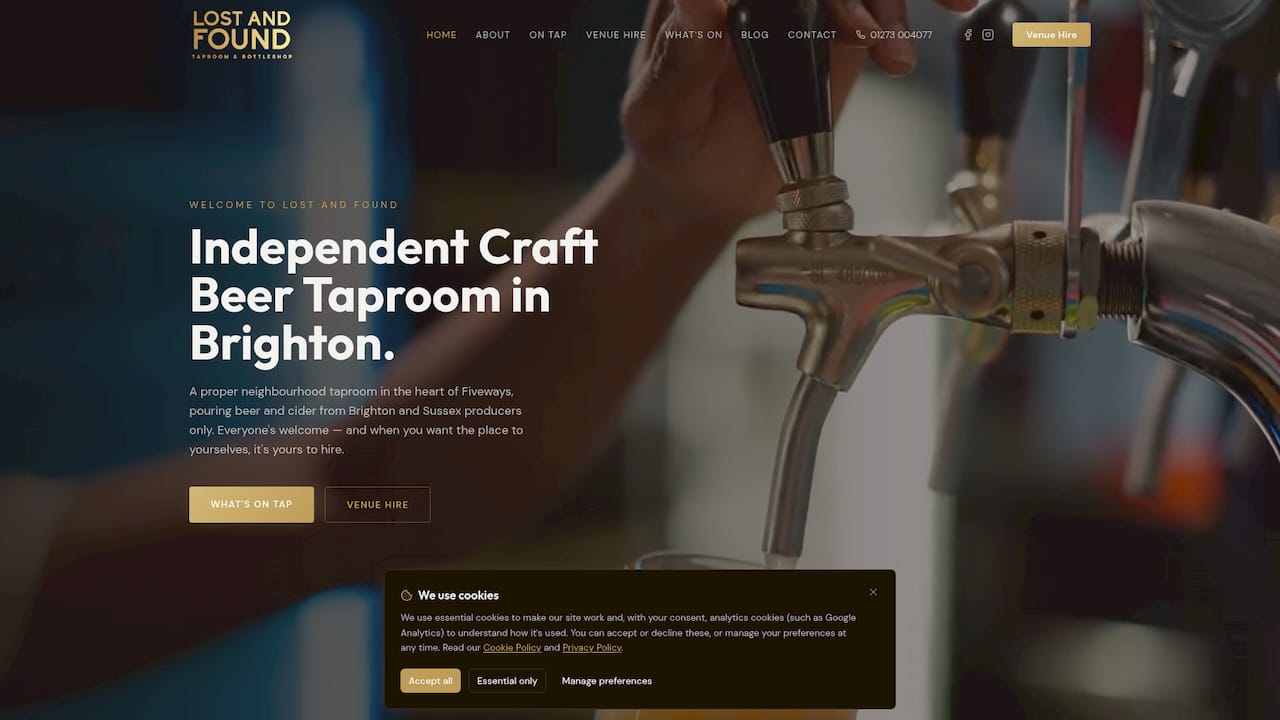
If queuing etiquette at a packed bar sounds like more than you fancy navigating on a given night, one option is choosing a venue where the flow of service is already sorted for you. Lost And Found Taproom in Brighton’s Fiveways focuses on Sussex beer and cider from independent breweries, alongside a bottleshop, wines and spirits, and food including XXL hot dogs and rotating street food vans, all served in a taproom where the menus are available online before you arrive.
For anyone planning an event rather than a casual pint, Lost And Found also offers venue hire. Both Midweek Hire and Weekend Hire come with exclusive use of the space and no hire fee, so you set the drink selection, decorations and music for your own event rather than working around someone else’s crowd and queue. That’s a genuinely different way to sidestep bar etiquette altogether: book the whole room, and there’s no invisible queue to read because there’s no one else’s order ahead of yours.
If you’d rather start smaller, check the current beer and cider selection to see what’s pouring, or look at the venue hire page if a private booking suits your next get-together better than another night working the bar queue.
Sources
The guidance in this article draws on current reporting and legal reference material on pub culture, service and licensing.
- How to not embarrass yourself in a British pub | BBC
- How to get served at the pub quickly | The Telegraph
- Licensing Act 2003, section 140
- Secret codes hospitality staff use (Liverpool Echo)
FAQ
What are the unwritten rules of British pub etiquette?
The core rules are to spread along the bar rather than forming a strict line, make eye contact with staff, have your order ready, and either join a round or opt out before it starts. Getting drinks in for the group, returning glasses and leaving promptly at last orders round out the main expectations, as BBC travel’s guide to pub culture describes.
What does a bar staff code like 68 actually mean?
Staff codes such as numbers or short phrases are internal shorthand for communicating between staff, not instructions for customers. Their meaning varies by venue: reporting on hospitality staff codes notes that “68” can signal a restock request in one system, but there’s no single meaning that applies everywhere.
Is it illegal to skip a queue at a bar?
Queue-jumping itself is a breach of etiquette, not a criminal offence. What can carry legal consequences is disorderly conduct on licensed premises, which under the Licensing Act 2003, section 140 can be an offence if allowed to continue, so a shove or aggressive confrontation over a queue position is a different matter entirely from simply cutting in.
Why do people queue side by side rather than in a line at bars?
Spreading along the whole bar lets multiple staff serve multiple customers at once, rather than everyone bottlenecking at one end of a single-file line. Pub managers interviewed by The Telegraph recommend using the bar’s full length and its edges specifically because it avoids the congestion a rigid queue creates.
Recommended
- Taproom Brighton: 7 Food and Beer Pairing Mistakes You’re Making (And How to Fix Them)
- Beer and Street Food in Brighton: Our Perfect Pairings Outside a Fiveways Taproom
- What Makes a Brighton Taproom Great? 5 Reasons Fiveways is the Heart of the Scene
- Meet the People Pouring Your Pint: The Regular Faces Behind Brighton’s Fiveways Taproom